Riding a motorbike in Bangkok is the fastest way to move around the city and the single riskiest thing most visitors do here. Both halves of that sentence are true. A scooter will beat a taxi across town at almost any hour, which is exactly why tens of thousands of Bangkok residents commute on one. It also puts you, unarmoured, into a traffic system where the vehicles around you are moving unpredictably and where a moment's misjudgement has no bodywork to absorb it.
Our honest position: if you are an experienced rider who has ridden in dense urban traffic before, Bangkok is manageable and after a week it is even enjoyable. If your riding experience is a scooter on a Greek island, do not learn here. Learn somewhere quiet — Hua Hin, Sukhothai, a provincial town — and come back to Bangkok later, or not at all.
- Where you rideThe left-hand lane, and the gaps between lanes
- ExpresswaysMotorbikes banned, all engine sizes, no exceptions
- Worst conditionsHeavy rain, and the first ten minutes of it
- Best hoursThe rush hour — when a bike beats everything else
What riding here actually involves
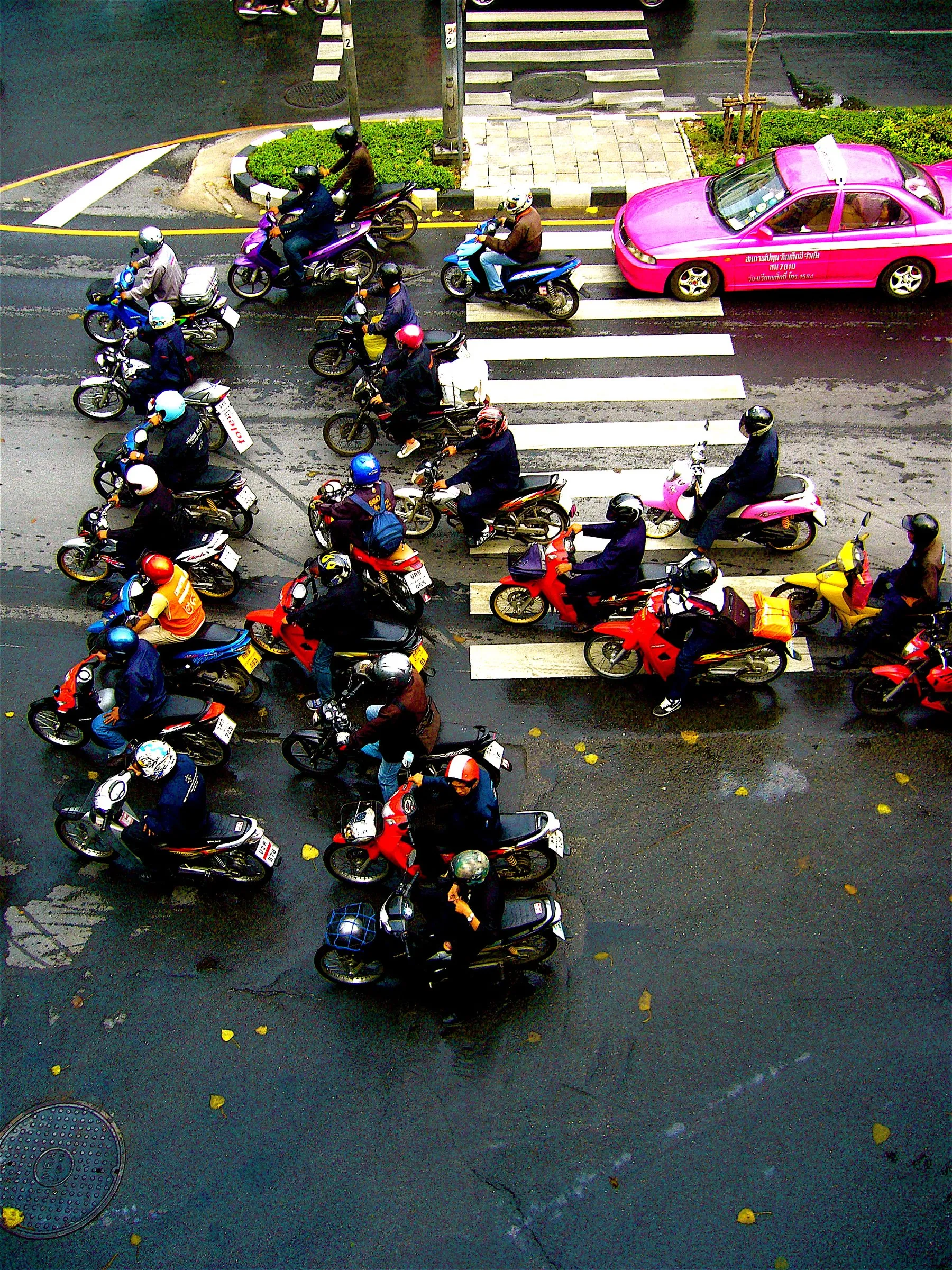
Bangkok traffic moves in a way that only makes sense from a saddle. Cars occupy lanes loosely; the space between lanes, and the space between the left-hand lane and the kerb, is understood to belong to motorbikes. You ride in it. Filtering is not merely tolerated here, it is the expected behaviour, and a rider who queues meekly behind a bus is doing something nobody around them anticipates.
At a red light, motorbikes flow to the front and gather in a block ahead of the stop line. When it goes green, that block launches together and disperses. Joining it is normal. Sitting in the middle of the car queue is not, and it is more dangerous, because you are then in the blind spots of vehicles who are not expecting to find you there.
The rules of the road as written, and the conventions that overlay them, are set out in motorbikes, filtering and Thailand's left lane. Read it before your first ride.
Where you cannot go
Motorbikes have been banned from Thailand's expressways and motorways for decades, regardless of engine capacity. There is no big-bike exemption and there is no discretion at the toll plaza. This matters more than it sounds, because Bangkok's elevated network is the fast way across the city and you do not have it. Your route is the surface streets, which are also where the queues are — the reason a bike is quick here is filtering, not speed.
Some road bridges and tunnels also exclude motorbikes, and the signage is usually a bike symbol in a red circle at the approach. Where a bike is excluded there is almost always a parallel surface route alongside. The network as a whole is explained in Thailand's expressways and motorways.
The wrong-way rider is the hazard you will not expect. On the kerb-side edge of many Bangkok roads, and in almost every soi, riders travel against the flow to avoid a long detour to a U-turn. It is illegal and ubiquitous. When you pull out of a soi, or move left towards the kerb, look both ways along the edge of the road — not just the way traffic is supposed to be coming from. See one-way streets and wrong-way riders.
The specific hazards
Bangkok's dangers are mostly mundane and repetitive rather than dramatic:
- Buses pulling out and stopping in the live lane. City buses stop where the stop is, not where it is safe, and pull back out expecting to be let in. Never sit alongside one; either be well ahead of it or well behind.
- Taxi doors. A taxi that has just stopped will discharge a passenger on the kerb side, into the exact strip you are riding in. Doors open without warning and passengers do not look.
- The surface. Steel drain covers, expansion joints on bridges and the thick painted lines at junctions are all slippery when wet, and Bangkok has more of them per kilometre than anywhere else in the country.
- Standing water. After rain, the kerbside strip fills first and hides everything in it — grates, kerbs, holes. Ride further out than usual.
- Delivery riders. Fast, paid by the drop, and filtering on both sides of you. They will overtake on your right and cut back left.
- U-turn crossings. The Bangkok U-turn gathers a queue of vehicles that then cross the whole carriageway. If you are filtering fast in the outside gap, you will meet a car nose-first.
Notably absent from that list is the aggressive driver. Bangkok's traffic is not hostile. The problem is density, unpredictability and the fact that everybody is squeezing through the same gaps.
Rain
The most dangerous ten minutes in Bangkok are the first ten minutes of a downpour, when months of oil and rubber lift off the road surface before the water washes them away. Grip vanishes, particularly on paint and metal, and visibility drops to almost nothing behind a wet visor.
The local answer is to stop. Riders pull under flyovers and petrol station canopies and wait. Do the same. A poncho is worth buying on day one — every 7-Eleven sells them for pocket change — but the poncho keeps you dry, not upright. The technique for riding in it, when you have no choice, is in riding a motorbike in tropical rain.
Gear, in a city where nobody wears any
You will see riders in shorts, flip-flops and no helmet. You will also see the consequences, and Thai hospitals have a name for the grazing that results. Helmets are required by law here — see Thailand's helmet law — and the rental helmet you are handed is usually the cheapest item in the shop. If you intend to ride more than once, buy your own; a decent full-face costs less than one hospital night. The reasoning is in choosing a helmet that actually protects you.
Beyond the helmet: proper shoes rather than sandals, gloves, and something with sleeves. Bangkok is hot and the temptation to ride in a t-shirt is strong; a long-sleeved technical shirt costs nothing in comfort and makes a low-speed slide survivable.
If you want the speed of a motorbike without the exposure, use a motorbike taxi. The riders in orange vests at the mouth of every soi do this for a living, they know the shortcuts, and they carry a helmet for you. For a two-kilometre hop in the rush hour, nothing else in Bangkok is close.
Renting, and the paperwork
Rental shops in the tourist districts will hand over a scooter easily, and the ease is misleading — the questions of what licence you must hold and whether your insurance responds are separate from whether a shop will rent to you. Settle both before you ride, starting with am I legal to drive in Thailand?, which covers both the licence and the insurance side. The practical side of hiring — what to photograph, deposits, damage claims — is in renting a motorbike in Thailand.
Police checkpoints are a routine feature of Bangkok riding, more common in the tourist districts and at night. They are ordinary, they are usually brief, and having your documents to hand makes them briefer.
So: should you?
A workable test. If you have ridden a motorbike regularly at home, in traffic, within the last couple of years, and you would be comfortable riding through central London or Rome, Bangkok is a step up in density but not in kind — go carefully, ride defensively, and you will be fine. If you have not, the risk is not worth the time saved in a city with a world-class metro and cheap taxis.
The middle path many people take is to leave the bike for elsewhere. Rent a scooter in Chiang Mai, Hua Hin or on an island, where the traffic is thinner and the roads more forgiving, and treat Bangkok as the place you take the train. What the city is like on four wheels instead is in driving in Bangkok.
Can I ride a motorbike on Bangkok's expressways?
No. Motorbikes are banned from all Thai expressways and motorways, whatever the engine size, and have been since the network opened. You ride the surface streets.
Is filtering between lanes legal in Thailand?
Filtering is the normal, expected behaviour in Thai city traffic and motorbikes are directed to the left-hand lane. The detail is in motorbikes, filtering and Thailand's left lane.
Is Bangkok worse than Ho Chi Minh City or Hanoi?
Different rather than worse. Bangkok has fewer bikes and more cars, so the traffic is heavier and faster in the gaps between jams, and the hazard profile is closer to a European city with far more two-wheelers in it.
What should I do when it starts raining?
Get off the road. The first minutes of rain are the slipperiest, and Bangkok's drain covers, bridge joints and painted lines become genuinely treacherous. Wait under a flyover or a petrol station canopy.
Do I need my own helmet?
Rental helmets in Thailand are usually the cheapest available and often poorly fitted. If you are riding more than a day or two, buy your own — the reasoning is in choosing a helmet that actually protects you.
Are motorbike taxis safe?
The riders are professionals who ride the same routes daily and are generally smooth. They are still motorbikes in traffic. They are a good option for short hops, and a far better one than riding yourself if you are inexperienced.