The short version: ride predictably, ride far enough left that you have somewhere to go, treat the hard shoulder as a two-way lane, and light yourself like a vehicle rather than a pedestrian. Thai drivers will not deliberately intimidate you, but they will not look for you either, and almost every close call a cyclist has here comes from being somewhere a driver did not think to check.
This is written for anyone riding on public roads in Thailand — the day-hirer heading out of Ayutthaya as much as the tourer on Highway 12 with four panniers. If you are only ever going to ride inside a historic park or around Bang Krachao, most of this does not apply to you. If you are going to be on a numbered road with lorries on it, all of it does.
Road position: further left than you think, but not in the gutter
Thailand drives on the left, and the traffic law expects a bicycle to keep as far to the left as is practicable. In practice that means the hard shoulder where one exists, and the left-hand edge of the left lane where it does not. If you are used to taking the lane in British or American traffic to make yourself visible, unlearn it here. Claiming a lane on a Thai highway does not produce a patient driver behind you; it produces an overtake into oncoming traffic that then squeezes back in.
The exception is at junctions and on narrow bridges, where the gutter is the worst place to be. Move out to the middle of the left lane before a junction where you intend to go straight on, hold it through, and drift left again afterwards. Do it early and unambiguously — a shoulder check and a clear arm signal well in advance works here; a last-second dart does not.
- Traffic sideLeft
- Default positionHard shoulder or far left of the left lane
- Highest-risk periodDusk and after dark
- Most common surpriseMotorbike on the shoulder, coming at you
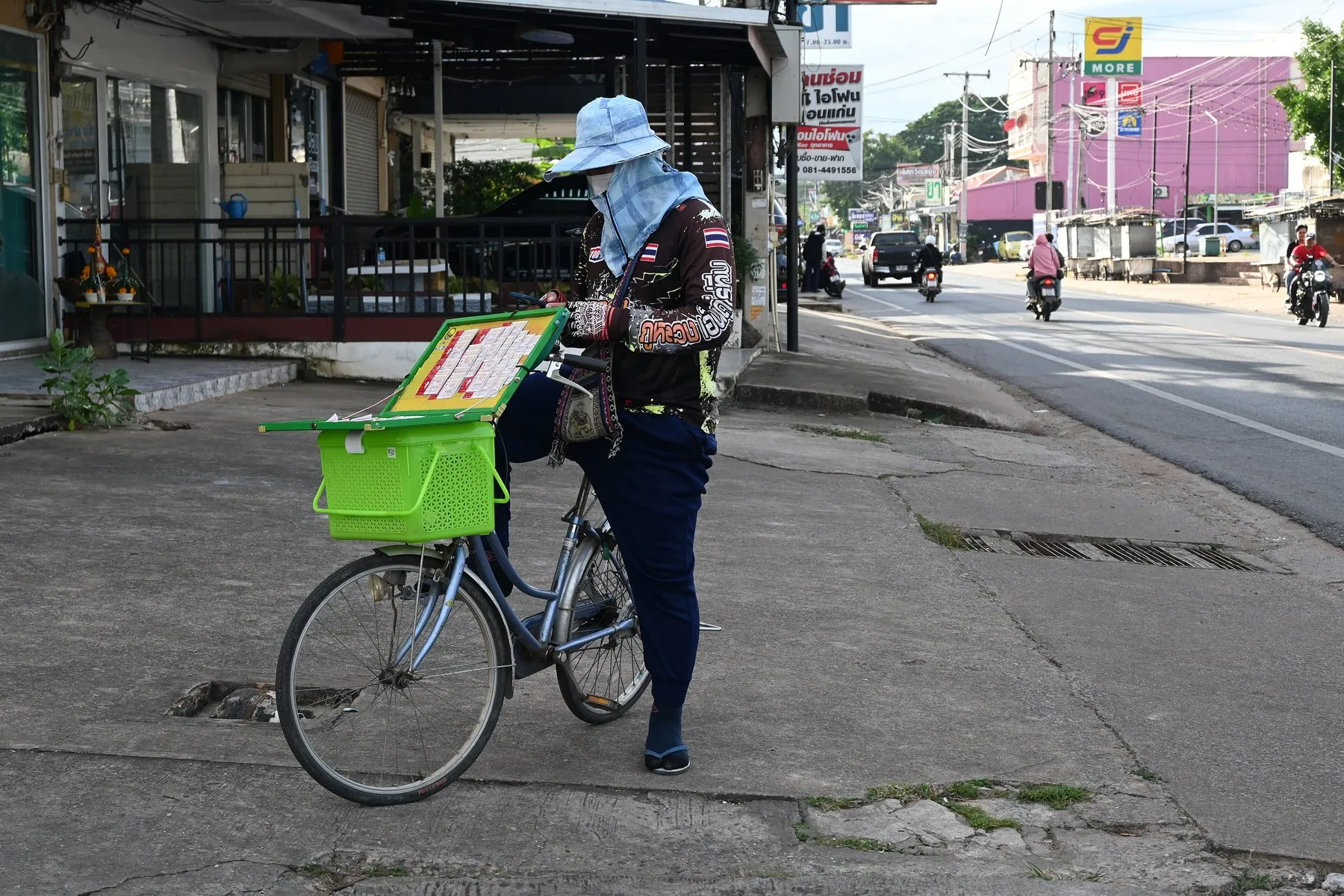
The hard shoulder is not yours
Thailand's paved shoulders are the reason cycling here works at all, and they are shared. Motorbikes use them as a slow lane in both directions, and wrong-way riding is completely normalised — a rider going a short distance will ride against the flow rather than go round to the next U-turn, and will do it without lights at night. Vendors set up in the shoulder. Songthaews stop dead in it. Broken-down lorries occupy it for days.
The habit that keeps you safe is scanning the shoulder ahead as actively as you scan the road. Ride with a metre of margin to your left so you always have somewhere to give ground, and slow before blind bends and crests. Hold a consistent line rather than weaving around each obstacle; a driver planning an overtake needs you to be where they last saw you.
The single manoeuvre worth practising is the give-way. An oncoming motorbike on your side of the shoulder will not move. Neither will a songthaew reversing out of a bus stop. You are the one with the least mass and the best view, and treating that as your job rather than an injustice is what keeps this workable. See one-way streets and wrong-way riders for how widespread this is.
Junctions, U-turns and the things that actually hit cyclists
Thai road design leans heavily on the U-turn. Rather than allow right turns across fast traffic, highways use a solid central barrier with periodic U-turn slots, so vehicles wanting to go the other way travel past their destination, turn and come back. For a cyclist this has two consequences.
First, you will need to do it yourself, and doing it in a fast highway U-turn slot on a bicycle is genuinely unpleasant — you are stationary in the middle of a road crossing two or three lanes. The safer move is almost always to dismount, walk to the central slot as a pedestrian, wait for a real gap and walk across. Nobody is watching and nobody cares. How U-turns work in Thailand covers the layouts you will meet.
Second, traffic emerging from a U-turn slot is accelerating hard and looking right, at cars. It is not looking at the shoulder on the far side where you are. Cover your brakes past every U-turn opening.
The other classic is the side soi. Vehicles pull out of side roads into the shoulder before joining the carriageway, effectively using your lane as a staging post. Assume every side turning will produce something, and assume the driver has looked past you.
Vehicles worth knowing by behaviour
| Vehicle | What it does around a bicycle |
|---|---|
| Pickup trucks | Everywhere, driven fast, often with people in the bed. Overtake close. Long overhang on the corner when loaded. See how pickups behave. |
| Songthaews | Stop instantly and anywhere, without indicating, usually in the shoulder. Passengers step out into your line. See songthaews and how they stop. |
| Coaches and ten-wheelers | Do not slow for you. The bow wave and the suction behind are the hazard, not the pass itself. Brace, hold your line, expect to be moved. |
| Small motorbikes | Overtake you on either side, ride the shoulder both ways, and rarely have working lights at night. |
| Farm vehicles | Slow, wide, and they shed mud and rice straw onto the road. Common in Isaan and the central plains. |
Being seen
Thai roads are visually noisy — neon, roadside stalls, oncoming headlights, unlit obstacles — and a cyclist is a small dim thing in the middle of it. Overspecify your lighting: two rear lights at different heights, one steady and one flashing, plus a front light that matters less for seeing than for being recognised by traffic emerging from side roads. Run them in daylight too. In flat midday glare, a flashing rear light is what makes a pickup driver realise the shape on the shoulder is slower than they assumed.
Carry spare batteries or a power bank, not just a charger. Dynamo hubs are the sane answer for a long tour here, because your riding hours are dawn and dusk and your charging opportunities are guesthouses. Kit that works in this climate is covered in cycling gear for a hot-climate tour.
Night riding: don't, mostly
Thailand's roads at night are a different risk category, and the reasons are the same for cyclists as for anyone else: unlit vehicles, unlit obstacles, roaming animals, drink-driving, and drivers who use full beam and do not dip. Add to that the fact that dogs are more territorial after dark. If you are on a tour, build your day so that you are off the road before dusk, which in Thailand arrives fast and at much the same time all year. The full picture is in driving at night in Thailand.
When you are caught out — a mechanical, a longer stage than planned, a headwind — the mitigations are to get onto the smallest road available, wear something reflective on your moving parts (ankles read as a cyclist far better than a static vest), and slow down enough that unlit potholes and dogs are survivable rather than terminal.
Rain and surfaces
The most slippery moment in Thailand is the start of rain after a dry spell, when oil and rubber lift off the surface. Painted lines, steel drain covers and polished village concrete are all far worse than the tarmac around them, and standing water hides potholes deep enough to stop a bicycle dead. Both the cyclist's guide to the rainy season and potholes and road surfaces in Thailand go into what to expect.
If it goes wrong
If you come off and someone else was involved, do not settle anything at the roadside before you understand what you are agreeing to; the process, including whether to call police, is in what to do after a road accident in Thailand. Keep the Thailand emergency numbers card saved offline, and check before you travel whether your policy covers you on a bicycle at all.
Habits that make the difference
- Ride between first light and 10:00 wherever possible. Less traffic, less heat, better drivers.
- Assume the shoulder has oncoming traffic on it at all times.
- Signal early and hold your line; predictability beats assertiveness here.
- Dismount and walk across highway U-turns rather than riding them.
- Two rear lights, always on, day and night.
- Cover the brakes at every side soi, U-turn slot and roadside stall.
- Prefer four-digit roads to two-digit highways, even at the cost of distance.
- Stop when you are cooked. Heat exhaustion is a judgement problem before it is a medical one.
None of this is a reason not to ride here. It is a reason to arrive knowing what the roads are like rather than finding out on day one — which is the whole point of what to expect from cycling in Thailand, and worth reading before you book anything.
Frequently asked questions
Should I ride in the hard shoulder or in the traffic lane?
The shoulder, in almost all circumstances, while remembering it carries two-way motorbike traffic. Move into the lane only where the shoulder disappears, at junctions where you are going straight on, and where the shoulder is obstructed. Thai traffic culture does not reward lane-claiming the way British traffic sometimes does.
Are hand signals understood in Thailand?
An outstretched arm is understood. Anything more elaborate is not. Signal well ahead rather than at the moment of the manoeuvre, and make eye contact where you can — a nod is the currency of Thai junction negotiation, as the unwritten rules of the road explains.
Is it legal to cycle on Thai highways?
Ordinary numbered highways are open to bicycles; tolled expressways and motorways are not. What the traffic law asks of a bicycle and its equipment is covered in bicycle law in Thailand, with enforcement and penalties in Rules & Police.
What do I do when a dog runs at me?
Stop pedalling, stay calm, keep the bike between you and the dog, and continue steadily past its territory. Sprinting turns a bluff into a chase. The full method, and what to do if you are bitten, is in dogs and cyclists in Thailand.
How do lorries and coaches treat cyclists?
As an obstacle to be passed at speed rather than a road user to be given room. They will not usually change lanes for you. Hold your line, do not flinch left into loose gravel, and expect to be pushed by the air. Buses and coaches on Thai roads has more.
Is Bangkok rideable?
Parts of it, on purpose, with a plan. It is not a city to improvise a route across on a bicycle. See cycling in Bangkok for the lanes and green spaces that work and the roads to avoid entirely.