Thailand is a good country to cycle in and a frustrating one, often on the same day. The riding is cheap, the food and water stops are constant, the surfaces on the main network are better than most of Europe, and nobody will hassle you for being on a bicycle. What Thailand does not have is a road system built with cyclists in mind. You share a wide hard shoulder with motorbikes, some of them travelling the wrong way, and you do it at 33 degrees with a dog watching you from the verge.
This page is written for two people. If you are a touring cyclist who has ridden in a dozen countries and wants to know what Thailand specifically will throw at you, most of what follows is for you. If you are on holiday and thinking about hiring a bike for a day around Sukhothai or Ayutthaya, skip to the section on where the easy riding is — your Thailand is a much gentler place than the one the tourer meets on Highway 4.
- Best monthsNovember to February
- Worst monthsMarch to May (heat and smoke haze)
- Traffic sideLeft
- The three problemsHeat, dogs, hard-shoulder traffic
What Thai traffic is actually like around a bicycle
Thai drivers are not hostile to cyclists. That matters, and it is not true everywhere. You will not be punishment-passed, you will not be shouted at from a window, and the aggressive-driver-versus-cyclist culture war that poisons riding in parts of Britain and Australia simply does not exist here. Cars give way to you at junctions more often than you expect. Pickup drivers wave you across.
What you get instead is indifference plus volume. Nobody is out to hit you, but nobody is looking for you either. Overtaking distances are decided by whatever gap exists, not by a rule, and the wind blast from a loaded ten-wheeler at 90 km/h will move you sideways if you are not braced. Understanding how Thai traffic actually works — the constant flow, the reluctance to stop, the informal negotiation at junctions — makes more sense of what you see than any rulebook.
The hard shoulder is the real story. On most Thai highways there is a generous paved shoulder, often two metres or more, and it is the best thing about riding here. It is also not yours. Motorbikes use it as a lane, some of them going the wrong way because riding against the flow is easier than riding to the next U-turn, and this is so normal it barely registers as a manoeuvre. Songthaews stop in it without warning. Vendors park in it.
Assume the shoulder is two-way. The single habit that keeps cyclists safe on Thai highways is scanning ahead for oncoming motorbikes on your own side of the road. They are usually small, often unlit after dark, and they expect you to move. Ride far enough left that you can give ground, and never take a blind bend on the shoulder at speed.
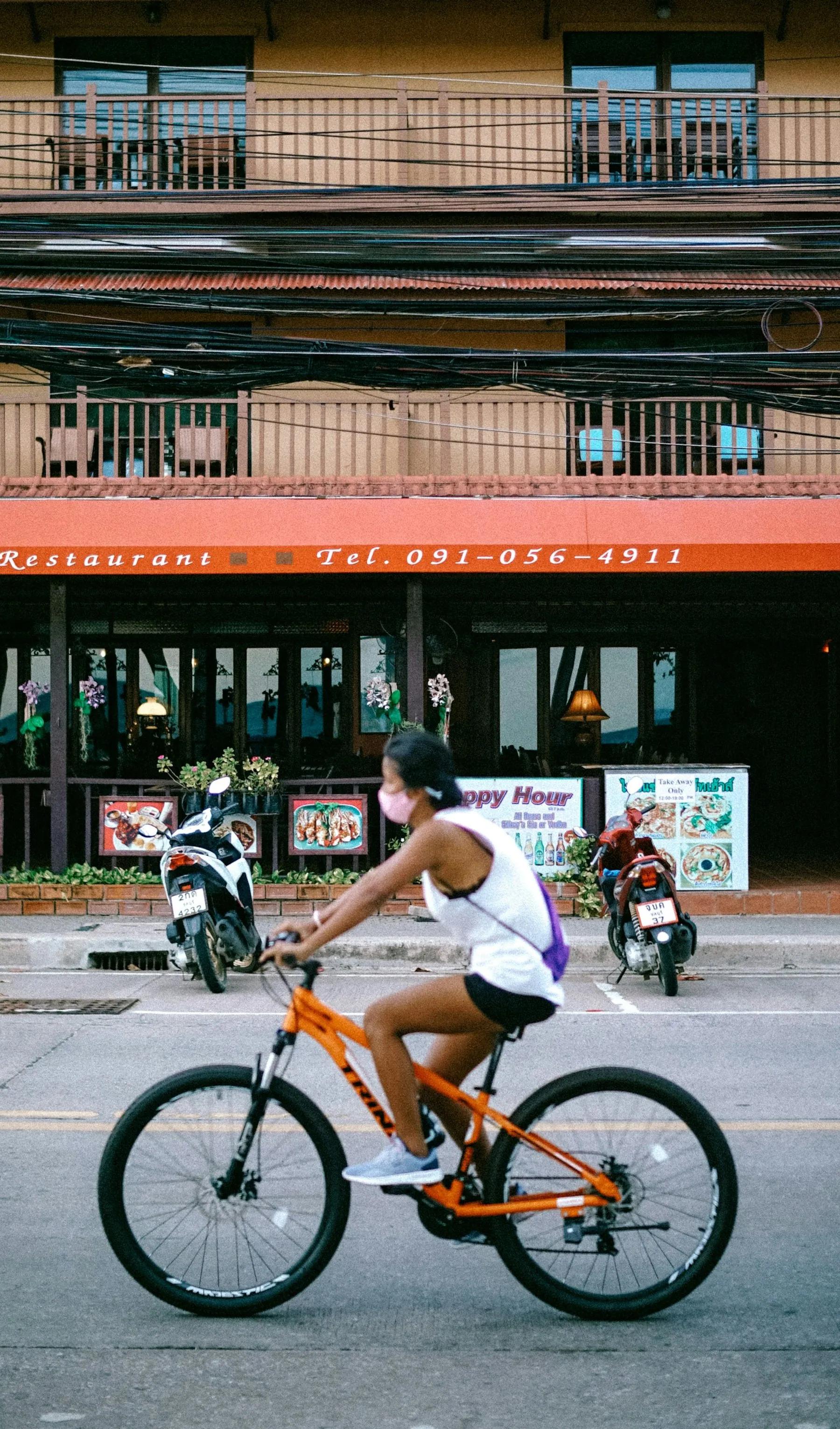
The heat is the thing that ruins first tours
People arrive with a plan built on European or American day-distances and give up in four days. Thailand's heat does not just slow you down; it changes what a day on a bike costs you. In the hot season, from March through May, inland temperatures regularly push past 38 degrees, and the humidity means sweat stops working properly as a cooling system. The tarmac radiates. There is no evening relief in April the way there is in a Mediterranean summer.
The practical consequence is that your riding day is roughly 06:00 to 11:00, with a long stop, and then perhaps a couple of hours from 16:00. Riding through the middle of the day is possible and thousands of people do it, but it is where heat illness comes from and it is why so many tourers here end up with a route half the length they planned. This deserves proper treatment rather than a paragraph, so we have given it one: see how to cycle in Thailand's heat and humidity for start times, salt and realistic distances.
Dogs
Ask any touring cyclist about Thailand and this comes up within a minute. Thai villages have free-roaming dogs, most of them loosely owned, and a proportion of them will chase a bicycle. It is territorial rather than predatory: they run out at the edge of their patch, escort you noisily for thirty or forty metres, and stop. It is genuinely alarming the first time, particularly at night, and it is one of the more common ways touring cyclists come off. The fix is a set of habits — do not sprint, do not kick, keep the bike between you and the dog — and they are covered in full in dogs and cyclists in Thailand. Drivers face the same problem in a different form; see dogs on the road.
Where the riding is genuinely good
Thailand is not one cycling country. It is at least four.
| Region | What it offers a cyclist | Best for |
|---|---|---|
| The north | Real mountains, long climbs, cool-season mornings, the best bike shops outside Bangkok | Climbers, loaded tourers, anyone with gears low enough |
| Isaan (northeast) | Flat to gently rolling, light traffic, four-digit back roads, the Mekong | First tours, high daily mileage, quiet |
| Central plains | Flat, hot, busy near Bangkok, superb historic parks | Day rides at Sukhothai and Ayutthaya |
| The south and islands | Coast roads, heavy tourist traffic, some brutally steep island hills | Short rides, chosen carefully |
The single best base in the country is Chiang Mai, and it is not close. Within an hour of the moat you have the Samoeng loop and the Doi Suthep climb, a genuine club scene, carbon road bikes to hire and mechanics who know what a through-axle is. Further out, Doi Inthanon and Doi Ang Khang are climbs that would be famous if they were in Europe, and the Mae Hong Son loop is one of the great mountain circuits in Asia. For a first tour with luggage, Isaan is the honest recommendation: flat, empty, cheap, and the part of Thailand where you are treated as a curiosity rather than a customer.
The day-hire reader: where a bicycle just works
If you want a bike for a day and no more, three places are made for it. Sukhothai Historical Park is flat, shaded, closed to through traffic in the central zone and cheap to hire in. Ayutthaya works the same way, though you are sharing streets with a living town. And in Bangkok, Bang Krachao — the river loop known as the green lung — is a maze of elevated concrete paths through mangrove where a car cannot follow you. None of these need any of the equipment or nerve the rest of this section talks about. See renting a bicycle in Thailand for what you get for your money and what to check before you ride off.
If your only cycling ambition in Thailand is a traffic-free hour or two at speed, the closed circuit around Suvarnabhumi airport is worth the taxi ride. Read the Sky Lane guide before you go — access has conditions.
What surprises experienced tourers
- Water is never a problem. Roadside shops appear every few kilometres almost everywhere, and cold drinks are cheap.
- Wild camping is rarely necessary. Guesthouses in small towns cost less than a meal at home.
- Road surfaces on the numbered network are mostly excellent; the failures are sudden and local, not general.
- Gearing is the equipment mistake. Northern gradients touch 20 per cent, and a compact chainset with a road cassette is not enough loaded.
- You will use lights far more than you expect, because dawn riding is the only comfortable riding.
- Thailand's road casualty record is poor, and cyclists are not exempt from it. Read the numbers honestly in what Thailand's road death statistics really say.
Frequently asked questions
Is cycling in Thailand safe?
It is riskier than cycling in northern Europe and safer than most people fear. The dangerous elements are highway traffic at speed, riding after dark, and the hot season. Cyclists who ride early, stay off two-lane national highways where a four-digit alternative exists, and light themselves properly have a very different experience from those who do not.
Do I need a helmet by law as a cyclist?
Bicycle equipment and where you may ride are covered by the traffic law, and we set out what it asks for — and what is actually enforced — in bicycle law in Thailand. Penalties and roadside enforcement live in Rules & Police.
When is the best time of year to cycle in Thailand?
November to February. Cool season mornings in the north can be genuinely cold, the humidity drops and the skies are clear. March to May is the hot season and the north also suffers agricultural burning haze. June to October is the southwest monsoon, which is wetter but far from unrideable — see cycling in Thailand's rainy season.
Should I bring my own bike or hire one?
For a tour, bring your own — hire fleets outside Chiang Mai and Bangkok are not built for loaded touring. For anything shorter, hire. Both routes are covered in bringing your own bike to Thailand and renting a bicycle in Thailand.
Can I ride on the expressways and motorways?
No. Thailand's tolled expressways and motorways are closed to bicycles, as they are to small motorbikes. You want the ordinary numbered highway network, and preferably the four-digit roads within it — see planning a quiet-road cycling route.
Is it worth cycling on the islands?
On some. Koh Yao Noi and Koh Lanta are pleasant; Koh Samui and Koh Chang are one steep hill after another with traffic that does not want you there. The honest island-by-island assessment is in cycling on Thailand's islands.