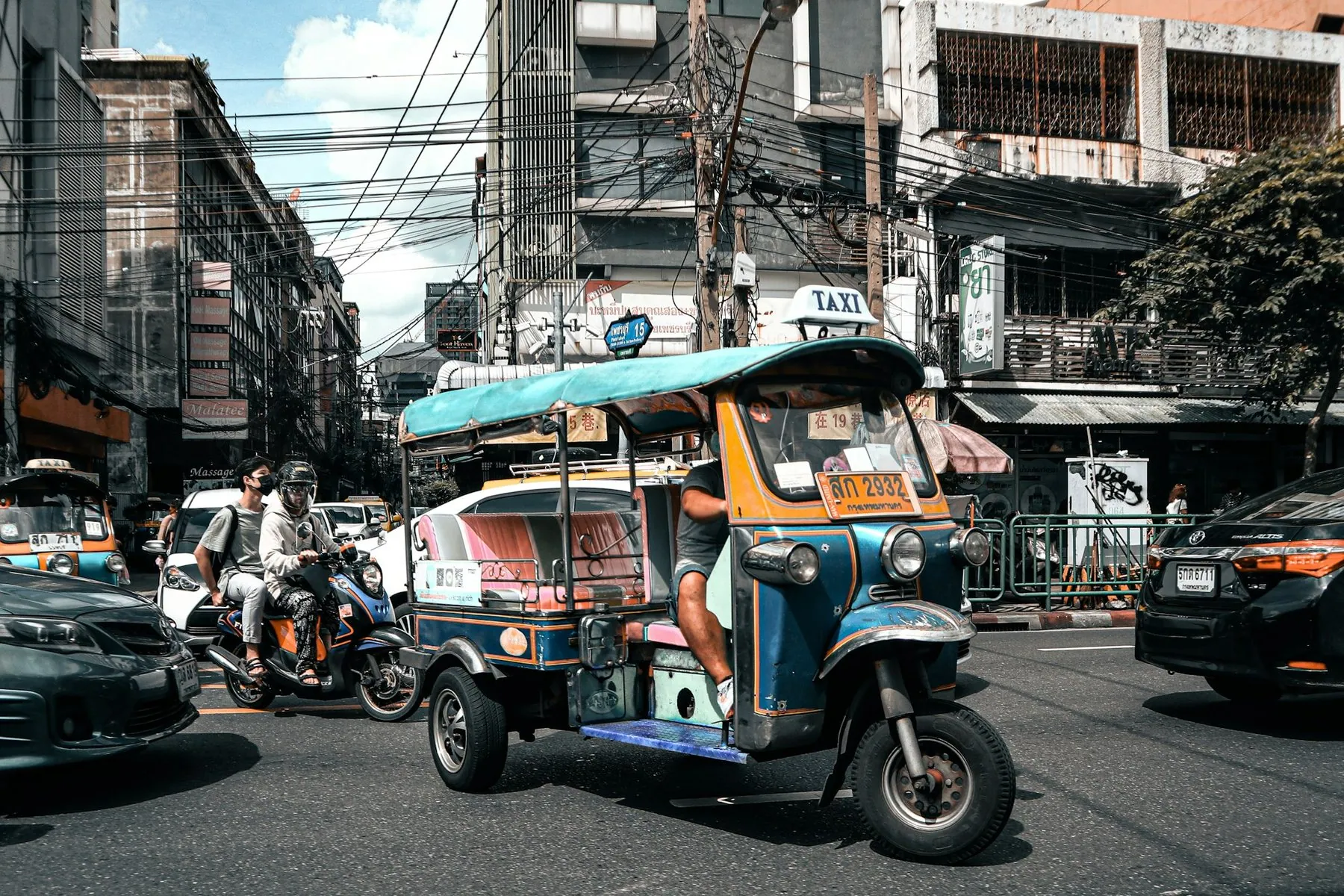
Thai traffic looks chaotic for about twenty minutes and then resolves into something quite orderly, provided you understand what it is organised around. It is not organised around the paint on the road, and it is not organised around the priority rules in the statute. It is organised around size, momentum and commitment: the vehicle that is bigger, faster or more obviously already committed to a manoeuvre goes first, and everybody else flows around it.
That sounds alarming written down. In practice it produces traffic far less aggressive than a European city: nobody is angry, and drivers make room for each other constantly. What it means is that you cannot drive here by asserting a right of way. You read intent, signal your own clearly, and give way to physics rather than to rules.
- Side of the roadLeft, by section 33 of the Land Traffic Act
- Real priority orderBus, truck, pickup, car, motorbike, pedestrian
- Turning left across a highwayUsually impossible; you U-turn instead
Left-hand traffic, and what actually catches people out
Thailand drives on the left. If you come from the UK, Ireland, Australia, New Zealand or Japan this costs you nothing; from continental Europe or North America it takes a day. The mechanics are easy; the reflexes are not. Looking the wrong way out of a car park, drifting right after a roundabout and reaching for a gear lever with the wrong hand all happen to competent drivers in week one. Driving on the left in Thailand covers the adaptation.
The one that matters most for safety is the pull-out glance. Thai hard shoulders frequently carry motorbikes travelling against the flow, so the direction you have just decided is "the empty way" is often not empty at all. Look both ways every time, from every exit, at every soi mouth. Wrong-way riding is a specific offence carrying a maximum of 2,000 baht precisely because it is so common and so lethal.
The U-turn is the backbone of the whole system
This is the biggest structural difference between Thai roads and the roads you learned on. Most Thai highways of any size are divided by a central barrier with no way to turn right across it, so you do not turn right at your destination. You drive past it to the next signposted U-turn slot — jut klap rot — turn through 180 degrees, and come back down the other carriageway to arrive on your left.
It also explains the strange-looking driving you will observe: vehicles crossing three lanes to reach the outside lane a kilometre before they need it, and traffic queuing in the fast lane for a gap. Some U-turn slots are bridges or underpasses, which are easy. Many are at grade, with no signals and no acceleration lane, which means pulling out from a standing start across two or three lanes of 100 km/h traffic. That manoeuvre deserves the most respect on the whole network; U-turns in Thailand goes through the rule and the reality.
What the law says
Sections 52 and 53 of the Land Traffic Act govern reversing direction. You may not U-turn where a sign prohibits it, in a safety zone, at a critical point, on a bridge or within 100 metres of a bridge approach, and not at a junction unless a sign permits it. On a two-way road you may not turn where another vehicle is approaching or following within 100 metres, unless it is safe and does not obstruct. The maximum fine under section 157 is 1,000 baht.
Motorbikes are a second, parallel traffic system
Roughly speaking, cars use the road and motorbikes use everything. They filter between lanes, occupy the space between the traffic and the kerb, ride the hard shoulder in both directions, gather in a shoal at the front of every red light and set off before you do.
The written rule is unambiguous and almost universally ignored. Section 35 requires motorcycles on a road with two or more lanes in the same direction to use the leftmost lane, or the lane next to a bus lane. In practice they use every lane, and the Act contains no offence of lane splitting at all — a rider filtering to the front at a red light is doing something the law does not address and police do not stop. Motorbikes, filtering and Thailand's left lane unpicks it.
Three habits handle most of it. Mirror-check before every lane change as a genuine look rather than a formality, because a bike can fill a mirror-sized gap in the time it takes to indicate. Never move left towards the kerb without checking down that side. And open doors slowly.
Priority: what the statute says, and what actually happens
The Act sets out ordinary junction rules. Give way to a vehicle already at the junction; where two arrive together, give way to the vehicle on your left; a main road has priority over a secondary road; where a left-turner and a right-turner meet, the left-turner gives way; and a vehicle emerging from a private road must stop and let road traffic pass.
Now the road. At an unsignalled junction, priority is negotiated rather than granted. A driver who eases their bonnet out into the flow has, in practice, taken priority, and traffic will absorb them. The vehicle that hesitates gets nothing. This is not rudeness — it is a functioning system that only works because everybody expects it and nobody is startled by it. The mistake a foreign driver makes is to assume that someone will yield because the rulebook says they should. Right of way in Thailand sets out both versions side by side.
Move slowly, predictably and continuously. Join Thai traffic by creeping out at a steady, obvious pace, so that everyone can see what you intend and adjust around you. Sudden decisiveness and sudden hesitation are both dangerous: the one thing this traffic handles badly is a vehicle that changes its mind.
Roundabouts, and why they are not what you expect
Thailand has roundabouts, but not the rule that makes roundabouts work elsewhere. Section 51(3) requires you to pass to the left of the island and section 70 to slow on approach, but the Act contains no general rule that traffic already on the roundabout has priority. Some are signalled, some are policed by hand at busy times, and the rest revert to the negotiated system above. Approach every one expecting entering traffic to enter. Roundabouts in Thailand covers the exceptions.
Lanes, overtaking and undertaking
The law says overtake on the right, then return to the left, and prohibits overtaking on the left except in narrow circumstances. It also says use the leftmost lane unless passing. In practice lane discipline is loose: the outside lane is not reserved for overtaking, vehicles pass on whichever side has space, and undertaking is ordinary behaviour rather than an outrage.
The practical consequences are simple. Do not sit in the outside lane expecting people to queue behind you; they will pass on the left. Check both mirrors before any lane change. And do not read a slow vehicle in the fast lane as an insult: they are probably positioning for a U-turn ahead. Lane discipline in Thailand goes further.
The signalling language
Thai drivers communicate constantly with lights and horn, and the vocabulary is not yours.
| Signal | What it usually means here |
|---|---|
| Short horn tap | "I am here" — informational, not angry. Used when passing, approaching a blind bend or coming alongside a bike. |
| Flashed headlights | Most often "I am coming through", the opposite of the British "after you". Assume the flasher intends to keep going. |
| Hazard lights at a junction | Often "I am going straight on" through a crossroads; also a warning of a hazard ahead. Ambiguous. |
| Left indicator on a highway | A genuine turn, or "safe to pass", or left on since the last junction. Do not act on it alone. |
Conventions vary regionally and by vehicle type; horn and headlight etiquette on Thai roads has the detail. The general rule: in Thailand a horn is information, not a complaint, and you should use it the same way.
The vehicles that behave differently
The rule of thumb: assume anything larger than you will take the space it wants, and anything smaller will appear from a gap you were not watching. Buses stay in whichever lane suits them, loaded pickups do not brake as their speed suggests, songthaews stop wherever a passenger raises a hand, and farm vehicles move at walking pace on roads where everything else is doing 90.
Frequently asked questions
Is Thai traffic actually dangerous or just unfamiliar?
Both, but not in equal measure across vehicle types. The traffic system itself is workable and low-aggression; the danger sits mainly with the exposure of motorcycles and with speed differentials on rural highways, not with the way priority is negotiated.
Why does nobody indicate?
Plenty do, but signalling is used less as a legal duty and more as one input among several. Position, speed and the angle of the front wheel tell you more about what a Thai driver is about to do than their indicator does. Read the vehicle, not the light.
Do I have to give way to traffic already on a roundabout?
The Act contains no general rule saying so, which is why Thai roundabouts do not behave like British ones. Slow down, pass to the left of the island, and expect entering traffic to enter.
What do I do when a motorbike comes at me on the wrong side?
Hold your line, slow down and move left within your lane if there is room. Do not swerve right into the oncoming lane. Wrong-way riding on the shoulder is common, and riders expect to weave around you.
How long does it take to feel comfortable?
A day or two on quiet roads, longer if you start in a city. Begin somewhere undemanding — Hua Hin, Chiang Rai or a provincial town — rather than making your first hour a Bangkok arrival. If you must start in the capital, read your first day driving in Bangkok first.