Thai roundabouts do not have a single priority rule, and that is not a criticism of Thai drivers — it is a fact about the law. The Land Traffic Act contains no general provision requiring you to give way to traffic already circulating. What it does contain is a rule that you pass to the left of the island, and a rule that you slow down on approach. Everything else is decided by the signs, the markings and the traffic lights at that particular roundabout, or by nothing at all.
The practical consequence for a visitor is simple: do not arrive at a Thai roundabout with a fixed expectation. Read it before you enter it.
- Direction of travelClockwise, island on your right
- General priority rule in the ActNone
- What decides prioritySigns, markings or lights at that roundabout
- On approachSlow down (s.70)
What the law says
Section 51(3): where the road has a traffic island or circle, the driver must drive the vehicle to the left of it. Section 70: the driver must reduce speed on approaching a junction, a pedestrian crossing and other defined points. Section 72: a vehicle on a main road has priority over one joining from a secondary road, where the junction is signed, marked or lined to that effect.
Notably absent: any general rule that traffic already on a roundabout has priority over traffic entering it.
Why direction matters more than priority
Because Thailand drives on the left, you go round a roundabout clockwise, keeping the island on your right. If you have come from the United States or continental Europe, that is the reverse of what your hands expect, and it is the error that produces a genuinely dangerous outcome rather than merely an awkward one.
Section 51(3) is the provision, and it is unconditional: you pass to the left of the island. There is no interpretation to be had. If you find yourself going anticlockwise you are driving into the oncoming stream, and the correction is to stop safely rather than to continue and hope.
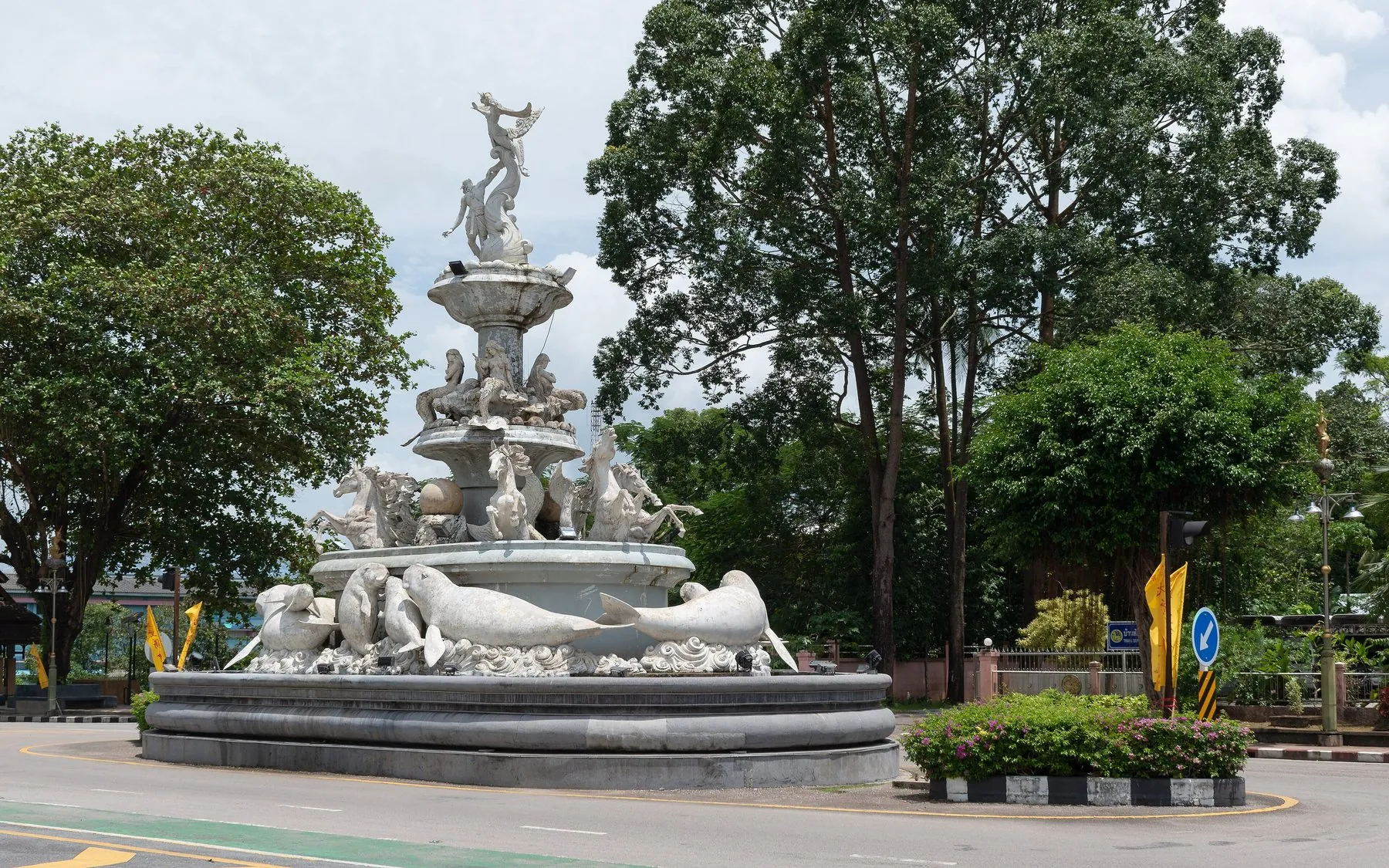
The four kinds of Thai roundabout
| What you see | How it works |
|---|---|
| Traffic lights on every arm | The lights decide, not the roundabout. Obey the signal and ignore roundabout logic entirely. Common on large city intersections |
| Give-way lines or signs on the approaches | Behaves like a European roundabout: circulating traffic has priority. This is the arrangement being installed on newer schemes |
| A police officer directing traffic | The officer overrides everything, including the lights. This happens at rush hour on busy circles |
| Nothing at all — no lines, no signs, no lights | The Act gives you no rule. Priority is negotiated. Slow to a crawl and read the traffic |
The last category is the one that unsettles visitors, and it is common in provincial towns. A large ornamental circle with a monument or a clock tower in the middle, four or five arms, and no markings whatsoever. There is no answer to "who has priority" because the law does not supply one. What happens is the ordinary Thai hierarchy: buses and trucks go, pickups go, cars fit in, motorbikes thread through. The full picture is in the unwritten rules of the road in Thailand, and it applies to roundabouts more visibly than anywhere else.
The single most reliable technique at an unmarked Thai roundabout is to enter behind a local vehicle and stay behind it until you are on your exit arm. You inherit its priority, its judgement and its momentum. It works even when you have no idea what the convention is at that particular circle.
How to drive one without incident
Approach slowly and look at the ground. Give-way lines, a dotted line across your approach, or a "Stop" marking tell you the roundabout has been signed as a main road under section 72, and that circulating traffic has priority. No markings means no rule.
Look for the lights before you look at the circle. On big urban roundabouts the signals are doing all the work and the circular shape is decorative. Signals can be set back from the roundabout itself.
Pick your lane late and expect not to keep it. Lane discipline within Thai roundabouts is loose. Vehicles cross your path from the inside to reach an exit, and motorbikes occupy whatever gap exists. Do not assume the car on your inside will stay there — see lane discipline in Thailand.
Signal your exit. Left indicator as you pass the arm before the one you want. Many drivers here do not, which is precisely why doing it yourself is worth something: you are removing one variable from everyone else's calculation.
Watch the near side on the way out. Motorbikes ride around the outside of the circle and along the kerb line. The collision to avoid is you exiting across a rider who was hugging the edge.
Do not stop dead on the circle. Hesitating in the middle of a Thai roundabout is more dangerous than making a decision. Traffic behind you is judging your speed to fit around you, and a sudden stop removes the gap they were aiming at. If you have missed your exit, go round again — that costs nothing.
Roundabouts worth knowing about
Bangkok's large circles — Victory Monument and Democracy Monument among them — are not really roundabouts in the sense a European driver means. They are multi-lane gyratory systems with signals, bus traffic, motorbike taxis operating from the kerb and pedestrians crossing where they can. They are demanding at any time of day and unpleasant at rush hour. Driving in Bangkok and Bangkok rush hour cover the wider problem.
Provincial circles are the opposite: quiet, decorative, and unmarked. Chiang Rai, Chiang Mai's outer road network and most Isaan towns have several. They are easy at ten in the morning and require attention at five in the afternoon.
Roundabouts on the tolled network are rare to non-existent — grade-separated interchanges do that job instead. That is one of several reasons the toll roads are the easiest driving in the country, as Thailand's expressways and motorways explained sets out.
On a motorbike
Roundabouts are one of the few places where a scooter has a real advantage: you are small, you can see over the traffic, and you can take a gap a car cannot. The corresponding disadvantage is that nobody is looking for you, and roundabout surfaces are frequently polished, oily and, in the wet, genuinely slippery at the entry and exit points where vehicles brake and accelerate.
Ride the circle rather than cutting across it, keep off the painted lines when it is raining, and be aware that a car exiting will not have checked its near-side mirror. Riding a motorbike in tropical rain covers the surface problem in more detail.
Frequently asked questions
Which way do you go round a roundabout in Thailand?
Clockwise, keeping the island on your right. Section 51(3) of the Land Traffic Act requires you to pass to the left of a traffic island or circle. It follows from Thailand driving on the left — see driving on the left in Thailand.
Who has priority on a Thai roundabout?
It depends on the roundabout. The Act contains no general rule giving priority to circulating traffic. Where the approaches carry give-way lines, signs or a stop line, the roundabout is the main road and circulating traffic has priority. Where there are traffic lights, the lights decide. Where there is nothing, priority is negotiated in practice.
Do I give way to traffic already on the roundabout?
Where the approach is marked or signed, yes. Where it is not, you have no legal obligation to and neither does anybody else — which is exactly why you should behave as though you do, and enter only into a gap you are sure of.
Do I have to indicate on a Thai roundabout?
The general signalling requirements apply, and you should indicate left before your exit. Many drivers do not. That is a reason to be predictable yourself rather than a reason to stop bothering.
What happens if I go round the wrong way?
You are driving against the flow of traffic, which since the 2022 amendment carries a maximum of 2,000 baht — and far more importantly, you are facing oncoming vehicles. Stop safely as soon as you can rather than trying to complete the circle.
Are Bangkok's big monuments roundabouts?
Functionally they are signal-controlled gyratories rather than priority roundabouts. Treat them as a sequence of traffic-light junctions arranged in a circle, follow the signals and lane arrows, and do not rely on roundabout convention.