Thailand drives on the left, and cars are right-hand drive. If you have come from the UK, Ireland, Australia, New Zealand, Japan, Singapore or Malaysia, that part costs you nothing. If you have come from the United States, Canada or anywhere in continental Europe, you have a day of deliberate concentration ahead of you and then it becomes automatic.
The rule is not merely convention. Section 33 of the Land Traffic Act requires a driver to keep to the left side of the road and not to drive beyond the median line, with a short list of exceptions: where something is obstructing the left, where a traffic officer has designated the road one-way, and where the road is less than six metres wide. Breaching it carries a fine of 200 to 500 baht under section 151 of the Act as originally drafted — a genuinely small sum, which tells you the law was never the thing that would stop you.
- Side of the roadLeft
- Steering wheelRight-hand side
- Overtaking sideThe right
- RoundaboutsClockwise, island on your right
What the law says
Section 33: the driver must drive on the left side of the road and must not drive beyond the median line, except where there is an obstruction on the left, where the road has been designated one-way by a traffic officer, or where the road is less than six metres wide.
The three moments that catch people out
Driving on the wrong side for a sustained stretch is rare. Foreign drivers almost never set off down the wrong carriageway of a busy road; the traffic tells them immediately. The errors happen in three specific situations, and they are worth naming in advance because they are entirely predictable.
Pulling out of a car park or a petrol station. You have stopped, you have been out of the car, and the automatic part of your brain has reset. You turn out of the forecourt and default to the right-hand side. This is the single most common way a visiting driver ends up head-on with something. The fix is mechanical: every time you rejoin a road from a standstill, say the word "left" out loud before you move. It feels ridiculous for two days and then you stop needing it.
The first turn of the morning. Same mechanism, different trigger. Cold start, quiet street, nothing to copy.
Turning right across traffic. In left-hand traffic, a right turn is the one that crosses the oncoming stream — the mirror image of a left turn at home. It is the manoeuvre that requires a gap, and it is the one where a driver used to right-hand traffic looks the wrong way first. In Thailand this compounds with a road-design problem: on divided highways there is often no right turn at all, and you are expected to carry on to a U-turn slot instead. That system has its own page, U-turns in Thailand, and it is worth reading before you drive out of the airport.
Put your passenger to work. For the first day, ask them to say "left" every time you rejoin a road and to check your near-side mirror at junctions. A second pair of eyes costs nothing and covers exactly the gap that a lifetime of right-hand-traffic habit leaves.
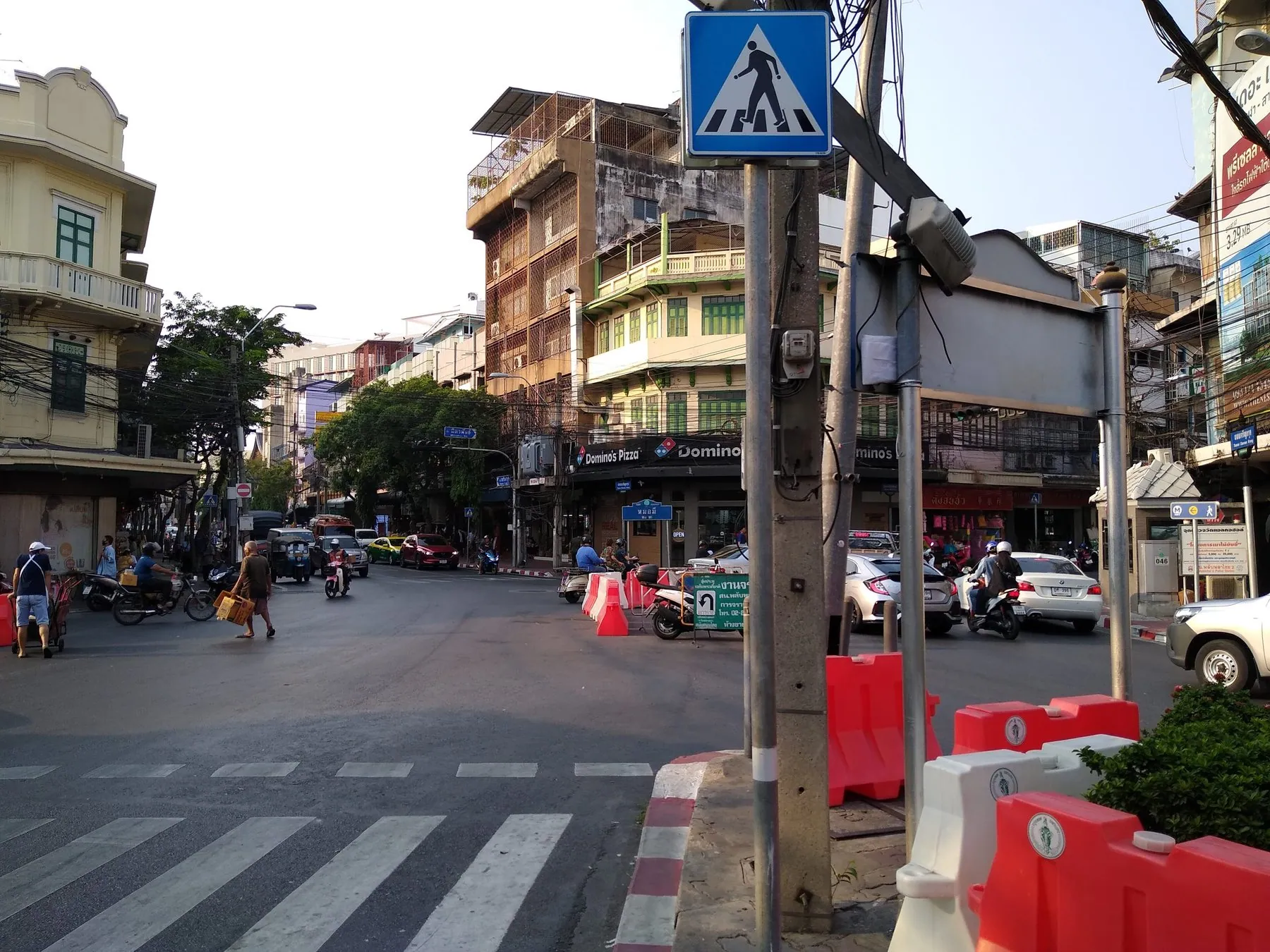
What changes inside the car
You sit on the right and you change gear with your left hand. Most drivers adapt to that within a few minutes; the pedals are in the same order, and clutch, brake and accelerator do not swap.
Two smaller things take longer. The first is your sense of where the car ends. Sitting on the right, you will instinctively position the car too far to the left and clip the kerb, or too far right and worry the centre line. Thai lane widths are generous on highways and mean in towns, so the error shows up in a narrow soi rather than on the open road. Give it an hour.
The second is the indicator stalk. The overwhelming majority of cars on Thai roads are Japanese-built or Japanese-designed, and on those the indicator is on the right of the steering column and the wipers on the left — the reverse of a European car. You will clean the windscreen at your first junction. Everybody does. It is not a problem; it is a signal that your hands have not caught up yet, and the appropriate response is to slow down for another twenty minutes.
Where left-hand traffic changes the rules themselves
Some rules are not just mirrored, they are genuinely different from what you may expect, and getting them wrong has consequences.
| Situation | The rule in Thailand |
|---|---|
| Overtaking | On the right, leaving an appropriate gap, then return to the left (section 44). Passing on the left is prohibited except in defined circumstances |
| Default lane | The leftmost lane, on any road with two or more lanes in the same direction (section 34) |
| Roundabouts | You pass to the left of the island — so you travel clockwise (section 51(3)) |
| Two vehicles arriving at a junction together | Give way to the vehicle on your left (section 71(2)) |
| A left-turner meets a right-turner | The vehicle turning left gives way to the vehicle turning right (section 51) |
| Motorbikes | Required to use the leftmost lane on multi-lane roads (section 35) |
Two of those are worth a second look. "Give way to the left" at a simultaneous arrival is the opposite of the priority-to-the-right convention that most of continental Europe runs on, and it is not intuitive if that is where you learned to drive. And the left-turner giving way to the right-turner is unusual enough that a lot of long-term residents do not know it. Both are set out in more detail in right of way in Thailand, which also explains why neither rule reliably describes what happens at an actual Thai junction.
The habit that matters more than any of this
Left-hand traffic is a mechanical adjustment. It takes a day. What takes longer, and what actually causes trouble for visiting drivers, is learning where the danger comes from on a Thai road — and the answer is almost always the near side, on two wheels.
Motorbikes are supposed to be in the left-hand lane, and often they are. They also use the hard shoulder, the pavement, the gap between lanes, and, routinely, the shoulder in the opposite direction to the traffic. That last one is the reason a foreign driver who correctly looks right before pulling out of a side road can still be hit: something is coming from the left, on the shoulder, against the flow. It is a real and frequent collision type. One-way streets and wrong-way riders covers it, and motorbikes, filtering and Thailand's left lane explains where riders are actually supposed to be.
Look both ways at every junction, every time, including the ones where the law says nothing can come from that direction. On a Thai road, "one-way" and "dual carriageway" describe where cars go. They do not reliably describe where motorbikes go.
Should you start on a scooter or in a car?
If you have never driven on the left, a car is the more forgiving place to learn. You are inside a structure, the mirrors are large, and a moment of confusion produces a wobble rather than a fall. On a scooter, the same moment of confusion happens at the same junction with nothing around you and, statistically, with no proper helmet.
Against that, a scooter is smaller, slower and far easier to park, and much of Thailand is genuinely more pleasant on two wheels. There is no single right answer, which is why we built the scooter-or-car tool rather than telling you. If you do take a car, an automatic removes one thing your left hand has to learn — see automatic or manual hire car in Thailand.
Wherever you start, do not make your first hour of left-hand driving your first hour in Bangkok. Hua Hin and the smaller provincial towns are far kinder to a new arrival, and if Bangkok is unavoidable, driving in Bangkok sets out what you are walking into.
Frequently asked questions
Does Thailand drive on the left or the right?
The left. Vehicles are right-hand drive, you overtake on the right, and roundabouts are taken clockwise. It is written into section 33 of the Land Traffic Act rather than being a matter of convention.
How long does it take to get used to driving on the left?
Most drivers are comfortable within a day and stop thinking about it within three. The residual risk is not the open road but the moment you rejoin traffic after stopping, which is where the old habit resurfaces. That risk lasts about a week.
Is it hard to drive on the left in Thailand specifically?
The left-hand part is no harder than anywhere else. Thailand is demanding for other reasons: traffic density, motorbikes on every side of you, and junction behaviour that does not follow the rule book. How Thai traffic actually works is the honest orientation.
Which way do I look first at a junction?
Right, because that is where the nearest oncoming traffic is in left-hand traffic. Then left, then right again — and mean the left check, because motorbikes on the shoulder travelling against the flow are common enough that it is a recognised collision type.
Are hire cars in Thailand right-hand drive?
Yes, effectively all of them, and most are Japanese models with the indicator stalk on the right of the column and the wipers on the left. Expect to wipe the screen instead of indicating at your first few turns.
What is the fine for driving on the wrong side?
Two different things get confused here. Failing to keep left under section 33 attracts a small fine — 200 to 500 baht under section 151 as originally drafted, roughly £5 to £11. Driving against the flow of traffic is a separate and more serious offence, with a maximum of 2,000 baht since the 2022 amendment. Both are ceilings, not the amount on a routine ticket.