If you want to make your first Thai drive somewhere forgiving, Hua Hin is probably the best choice in the country. The roads are wide, the traffic is light outside a couple of pinch points, the layout is a simple ladder hanging off one main road, there are no hills in town, and the local driving culture is noticeably calmer than Bangkok's or Phuket's. It is a town of retirees, weekenders and golfers rather than backpackers on scooters, and it feels like it.
That does not mean it is empty. Hua Hin is Bangkok's nearest proper beach and it fills at weekends, and its one main road carries both the town's local traffic and the national trunk route to the south. Learn where those two things collide and the rest of the town is easy.
- Main roadPhetkasem Road, Highway 4, running north to south
- From BangkokAround 200 km, roughly three hours in good conditions
- Worst hoursFriday evening arrivals, Sunday afternoon departures
- Town centreWalkable; a car is for getting out of town
The layout
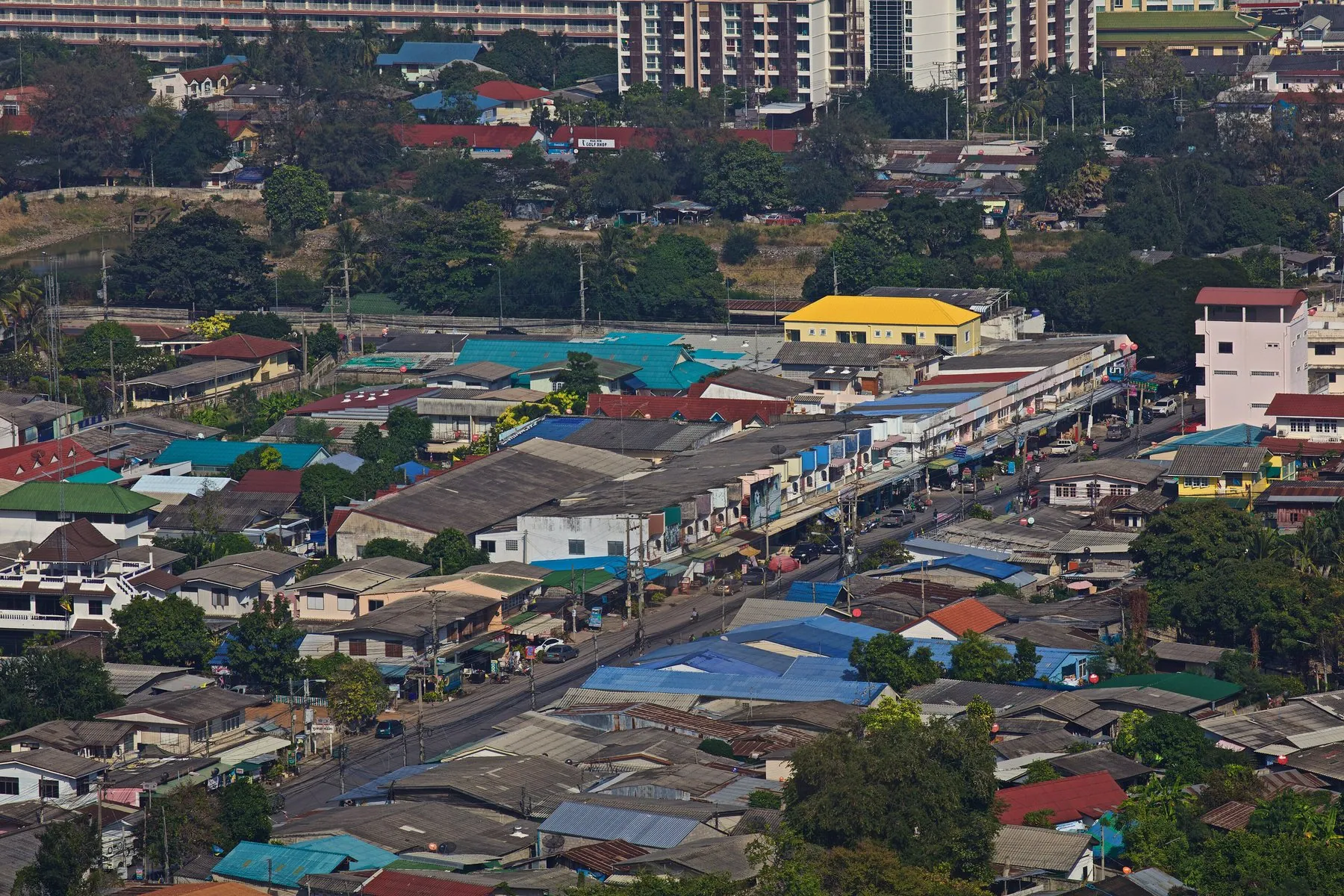
Hua Hin is arranged along Phetkasem Road, which is Highway 4 — the same road that runs from Bangkok all the way to the Malaysian border. Through the town it is a busy urban artery with traffic lights, shops on both sides and a constant stream of motorbikes. Off it, numbered sois run down towards the sea on one side and inland on the other, using the standard Thai convention of odd numbers on one side and even on the other. Give somebody a soi number here and they know precisely where you mean.
The old town sits between Phetkasem and the beach. Damnoen Kasem Road runs from the railway station down to the sand and is the main visitor axis. Naresdamri Road runs parallel to the shore behind the seafood restaurants and the piers, and is narrow, slow and busy on foot. Dechanuchit Road carries the night market, which closes the street to vehicles in the evening — a road that is perfectly normal at four in the afternoon and a pedestrian precinct at seven.
Khao Takiab, the headland with the temple and monkeys, is a few kilometres south along the beach road. Cha-Am is about 25 km north. Both are easy drives.
Highway 4 has a bypass running around the western edge of Hua Hin. If you are travelling through — heading south towards Prachuap and the gulf coast, or north to Bangkok — use it rather than driving through the town, and drop back in on whichever numbered soi is closest to where you are staying. It saves a set of traffic lights every few hundred metres.
Where the traffic is
Hua Hin's congestion is specific and predictable:
- Phetkasem Road through the centre, particularly around the junctions with the main sois and near the hospital, at the school peaks and again in the early evening.
- The night market area around Dechanuchit and Phetkasem from late afternoon, when the market sets up and the surrounding streets fill with parked cars.
- The mall entrances — Bluport and Market Village both sit on Phetkasem and their access is from the main road.
- Friday evening and Sunday afternoon, which are the weekend tides in and out of Bangkok. On a long weekend these become genuinely slow, and the whole Bangkok–Hua Hin corridor is covered in driving Bangkok to Hua Hin.
Away from those, Hua Hin moves. Mid-morning on a Tuesday you can cross the town in ten minutes.
The junctions to watch
Phetkasem through Hua Hin is a divided road for much of its length, and the same principle applies as everywhere else in Thailand: you often cannot turn right directly, and the movement is handled at a U-turn point or a signalised junction further along. If your hotel is on the other side of Phetkasem, expect to drive past it. U-turns in Thailand covers the technique.
The junctions where a soi meets Phetkasem are the ones that catch people. A rider emerging from a side soi onto a wide, fast main road frequently looks only for the nearest lane of traffic and pulls into the path of something in the outer lane. If you are on Phetkasem, watch the mouth of every soi. If you are pulling out of one, take the extra second.
Signals have been added at some of the busier soi junctions in recent years, including at Soi 51 and near the hospital, which has made those crossings safer and the road slightly slower. Do not assume a soi junction you used last year is unchanged.
Parking
This is where Hua Hin is genuinely relaxed. The shopping centres — Bluport and Market Village, both on Phetkasem — have large free or near-free car parks with motorbike areas. Most hotels have their own parking, including a good number of the smaller ones, which is unusual for Thailand. There is on-street parking in the old town, and outside the evening market hours you will usually find a space within a couple of minutes' walk of wherever you are going.
The national kerb-colour rules still apply — red and white means no stopping at all, yellow and white means a brief drop-off only — and the streets around the night market are enforced in the evening because they have to be. See parking rules in Thailand and Thai road markings and kerb colours.
Why a car is worth it here
Hua Hin town is walkable, and if you are staying near the beach you may not need a vehicle for days at a time. What a car buys you is the surrounding area, which is underrated and almost entirely inaccessible without one:
- Pala-U — Highway 3218 runs west from Hua Hin into the hills towards Kaeng Krachan national park and the Pala-U waterfall. A pretty, easy road that climbs gently and gets progressively emptier.
- The vineyards and the hill viewpoints inland, all a short drive on quiet roads.
- Cha-Am and the coast north, and the beaches and fishing villages south towards Pranburi and Sam Roi Yot, where the limestone hills meet the sea.
- The long run south — Hua Hin is the top of the Gulf coast drive to Surat Thani, a coast most visitors fly over.
Because the roads around Hua Hin are wide, well surfaced and lightly trafficked, this is also a sensible place to get your first hours of Thai driving in before tackling anything harder. Local hire is covered in car hire in Hua Hin.
Riding here
Hua Hin is a reasonable place to ride a scooter for the first time — gentle roads, no hills in town, and space to make a mistake. The two things that still apply are Highway 4 itself, which is a national trunk road with lorries on it and not a place to potter, and the standard Thai hazards after dark. Read driving at night in Thailand and Thailand's helmet law before you take a bike out, and if you are weighing two wheels against four, work out which suits your trip.
Is Hua Hin a good place to drive for the first time in Thailand?
Probably the best in the country. Wide roads, light traffic, no hills, calm local driving and easy parking. The main road is still a national highway, so treat Phetkasem with respect.
How long does it take to drive from Bangkok to Hua Hin?
Around three hours in reasonable conditions for roughly 200 km, and considerably longer on a Friday evening or before a public holiday. The route and the alternatives are in driving Bangkok to Hua Hin.
Do I need a car in Hua Hin?
Not for the town itself, which is walkable. You need one for Pala-U, the vineyards, Pranburi, Sam Roi Yot and the coast — which is most of the reason to come.
Where do I park for the night market?
Not on Dechanuchit Road, which closes to vehicles in the evening. Use one of the mall car parks on Phetkasem and walk, or park a few streets back in the old town and accept a five-minute walk.
Is there a bypass around Hua Hin?
Yes — Highway 4 runs around the western side of the town, with turn-offs onto the numbered sois. Use it for through journeys rather than driving the length of Phetkasem.
Are there police checkpoints around Hua Hin?
Yes, as everywhere in Thailand, typically on Phetkasem and at the approaches to town. They are routine. What one involves is in police checkpoints in Thailand.