From Hua Hin to Surat Thani is around 480km down the western shore of the Gulf of Thailand, on Highway 4 as far as Chumphon and then Highway 41. It is about six hours of driving if you treat it as a transfer, and three or four days if you treat it as a trip. Almost nobody does the second, which is why the beaches along it are empty.
This is the stretch of Thailand that everyone flies over. The traffic on the ground is people going somewhere else: to the Samui ferries, to Phuket, to Malaysia. Meanwhile the coast between Pranburi and Chumphon has national parks with wild elephants, limestone caves with royal pavilions inside them, and a series of beach villages with no foreign visitors at all.
- DistanceAbout 480km
- As a transfer6-7 hours
- As a trip3-4 days
- RoadsHighway 4, then Highway 41 from Chumphon
- Wettest monthsOctober to December
The route
| Leg | Road | Roughly | What is there |
|---|---|---|---|
| Hua Hin - Pranburi | Highway 4 | 30km | Quieter beaches, mangrove forest park |
| Pranburi - Sam Roi Yot | Highway 4 and coast roads | 30km | National park, Phraya Nakhon cave |
| Sam Roi Yot - Prachuap Khiri Khan | Highway 4 | 60km | Kui Buri elephants, the narrow isthmus |
| Prachuap - Ban Krut and Bang Saphan | Highway 4 | 90km | Long empty beaches |
| Bang Saphan - Chumphon | Highway 4 | 110km | Coconut country, Koh Tao ferries |
| Chumphon - Surat Thani | Highway 41 | 190km | Fast inland highway |
Note the change at Chumphon. Highway 4 turns west there and crosses to the Andaman side at Ranong, which is where the Andaman coast road trip begins. Highway 41 branches south and runs inland to Surat Thani, Nakhon Si Thammarat and eventually Phatthalung. If you are heading for the Gulf islands, Highway 41 is your road.
Why you leave the main highway
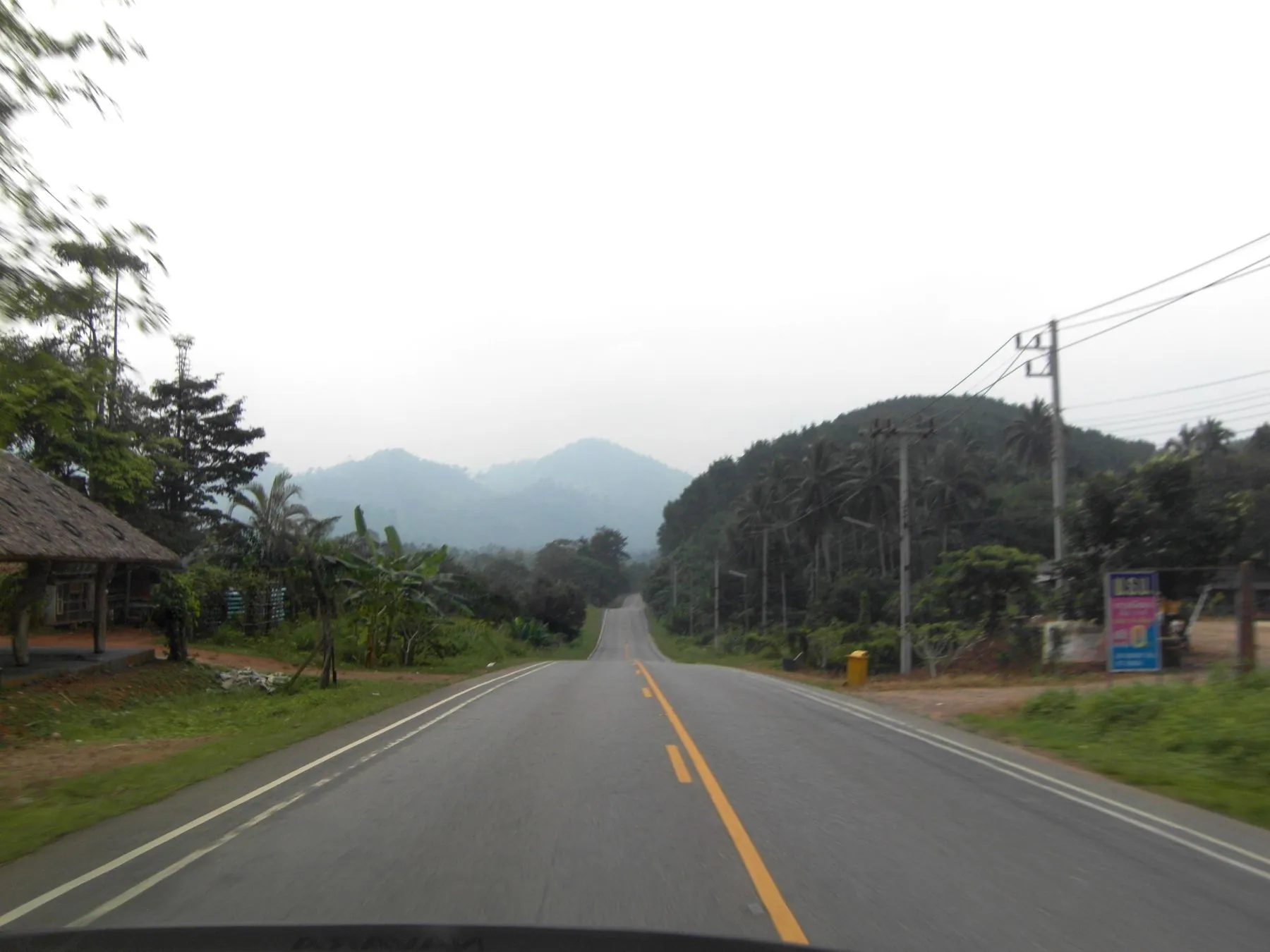
Highway 4 down this coast is a wide, fast, four-lane road, and it is set back from the sea almost the whole way. You can drive the entire length of the Gulf coast and never see the Gulf. The interesting driving is on the side roads that run out to the shore and back.
Khao Sam Roi Yot National Park, about 60km south of Hua Hin, is the best of them: a cluster of limestone peaks rising straight out of marsh and sea, with a coastal road threading between them. Phraya Nakhon cave, inside the park, has a collapsed roof through which a shaft of sunlight falls onto a royal pavilion built there in the 1890s — around mid-morning, on a clear day. Reaching it means a boat from Bang Pu or a steep 20-minute climb over a headland, and then a second climb down into the cave.
Kui Buri National Park, inland from Highway 4 north of Prachuap, is the most reliable place in Thailand to see wild elephants. Rangers run late-afternoon truck trips to viewing areas at the forest edge where herds come out to feed. It is not a zoo and there is no guarantee, but the odds are good.
Prachuap Khiri Khan is the pick of the towns. It sits in a curved bay with a promenade, a fishing fleet, and Khao Chong Krachok — Mirror Mountain — a monkey-infested limestone stack with a temple on top and 400-odd steps to reach it. The macaques are aggressive about food and bags. South of town, Ao Manao is a beach inside an air force base, open to visitors, and is one of the cleanest and least developed on the coast. This is also close to the narrowest part of Thailand, where the country is barely ten kilometres wide between the Gulf and the Myanmar border.
Ban Krut and Bang Saphan Yai are long, straight, quiet beaches with a scatter of small resorts, reached by short side roads off Highway 4. They are what Hua Hin looked like decades ago and they are almost entirely Thai.
Drive the coast roads, not the highway
Between Pranburi and Prachuap there is an almost continuous set of minor roads running nearer the shore, through pineapple fields, fishing villages and shrimp farms. They are slower, narrower and far more interesting than Highway 4, and they rejoin it whenever you want. This is the single best decision you can make on this drive.
What the driving is like
Easy, and dull on the main road. Highway 4 here is a modern four-lane divided highway with a hard shoulder and generous sight lines. Highway 41 south of Chumphon is similar. Neither has any real terrain.
The hazards are the standard southern ones:
- Lorries, and a great many of them. This is the trunk route between Bangkok and the whole of the south. Rubber, palm oil, fish and construction traffic run all day and all night.
- U-turn bridges instead of right turns. You will drive past your destination and come back. See U-turns in Thailand.
- Motorbikes on the hard shoulder, including against the flow of traffic, at every town.
- Sudden rain. Tropical downpours on a fast four-lane road cause standing water and aquaplaning. See the rainy season and flooded roads.
- Sand on the coast roads. Blown sand at the edge of beach lanes is genuinely slippery on two wheels — see sand and gravel on coastal roads.
Do not drive Highway 4 or Highway 41 at night if you can avoid it. Both carry heavy long-distance lorry traffic in the dark, much of it running to a schedule, and both pass through unlit villages where motorbikes and pedestrians appear without warning. Overnight coaches on this corridor have a poor record. Plan your days to finish before dusk — see driving at night in Thailand.
When to go
The Gulf coast runs on a different calendar from the Andaman side, which surprises people.
January to August is broadly the good period on this coast, with the driest and clearest weather in the first months of the year. While Phuket and Krabi are being soaked by the southwest monsoon between May and October, the Gulf shore is comparatively sheltered.
October to December is the wet season here, driven by the northeast monsoon, with the peak rainfall usually in November. This is the one time of year when the Gulf coast is genuinely worse than the Andaman side. Roads flood locally, ferry services to the islands are disrupted, and heavy rain on Highway 41 is unpleasant.
If you are combining a road trip with the islands, that difference matters. See the Koh Samui vehicle ferry for how the crossing from Don Sak works, and taking a car or motorbike on a Thai island ferry for whether you should bother.
Which vehicle
A car, for the whole run. It is a long, hot, fast highway and there is nothing here that a motorbike does better.
The exception is if you base yourself somewhere — Prachuap or Bang Saphan — and explore the coast roads locally. That is excellent scooter territory: flat, quiet, short distances and a beach every few kilometres. Rentals in these towns are local operations rather than tourist ones, and English may be limited.
Hua Hin is the obvious place to pick up a car for this drive; Surat Thani is the obvious place to drop one, and it has the region's main airport and ferry connections. See car hire in Hua Hin and car hire in Surat Thani. One-way hire between the two is possible with the larger firms and attracts a fee — see one-way car rental in Thailand.
A three-night version
Night one: Pranburi or Sam Roi Yot. Only an hour from Hua Hin, which feels lazy, but it puts you at the national park gate for the morning boat to Phraya Nakhon cave.
Night two: Prachuap Khiri Khan. Kui Buri elephants in the late afternoon on the way down, then the promenade and the seafood market in the evening.
Night three: Ban Krut or Bang Saphan. A beach with nothing on it, which is the point.
Day four: the run through Chumphon and down Highway 41 to Surat Thani, about four hours, for the ferry or the flight.
Chumphon is the departure point for the fast boats to Koh Tao, and Surat Thani serves Samui and Phangan via the pier at Don Sak. If your trip ends on an island, work out the ferry timetable before you plan the driving days, not after.
Frequently asked questions
How long does it take to drive from Hua Hin to Surat Thani?
Six to seven hours of driving for about 480km if you do it in one go on Highway 4 and Highway 41. It is a perfectly manageable single day, but there is no reason to make it one unless you are catching something.
Can you see the sea from the road?
Rarely, on the main highway. Highway 4 runs several kilometres inland almost the whole way. The sea is on the side roads, and finding them is the whole skill of this drive.
Where is the best place to stop?
Prachuap Khiri Khan, for the bay, the monkey temple and Ao Manao beach. Khao Sam Roi Yot for the caves and the limestone scenery. Ban Krut if you want a beach with nobody on it.
Is this a good drive in the rainy season?
Between May and August, yes — this coast is sheltered from the southwest monsoon that soaks the Andaman side. Between October and December it is the wet coast, and November is the peak. Plan around that rather than around the general idea of a Thai rainy season.
Can I see wild elephants?
At Kui Buri National Park, with a good chance. Rangers run late-afternoon vehicle trips to viewing areas where herds emerge from the forest. It is genuinely wild, so there is no guarantee, and you should not approach elephants on the road anywhere in Thailand.
Should I continue to Phuket or to Samui?
At Chumphon the country splits. Highway 4 turns west to Ranong and the Andaman coast; Highway 41 runs south to Surat Thani and the Gulf islands. You cannot easily do both on one trip, so decide before Chumphon.
For the wider region see driving in southern Thailand, and for the road itself, Highway 4: Phetkasem. Coming from the capital, start with Bangkok to Hua Hin.