Twice a day, for about forty minutes each time, the road outside a Thai school becomes the most hazardous stretch you will drive on. Children on foot, children two and three to a scooter, parents stopped in the live lane with hazards on, motorbike taxis reversing, food vendors, and a crossing guard who may or may not be there. The speed limit drops on approach, usually well before the buildings start, and enforcement is concentrated exactly there.
The practical answer is short: slow to a crawl, cover the brake, expect a child to step out from between parked vehicles, and do not attempt to make progress. You will lose two minutes. It is the cheapest two minutes of your trip.
- Typical school hours07:30–08:30 and 15:00–16:30
- Reduced limitPosted; obey the sign
- Legal duty on approachSlow down (s.70)
- EnforcementConcentrated at drop-off and pick-up
What the law says
Section 70 requires a driver to reduce speed on approaching a junction, a pedestrian crossing and other defined points. Section 67 requires you to drive at the speed set by ministerial regulation or by the sign on the road, and a sign may set a maximum lower than the regulation. Where a reduced limit is posted outside a school, that posted figure is the limit that applies to you.
Speeding carries a maximum of 4,000 baht since the 2022 amendment — roughly £90 — and it is first on the list of ten offences the Royal Thai Police named for strict enforcement from April 2026.
How school zones are signed
The warning sign is the international one: a triangle, red border, with two children walking. It is often supplemented by a rectangular sign showing a reduced speed limit, and on rural highways by a run of rumble strips or painted transverse bars across the carriageway.
What you should not expect is a consistent presentation. On a well-funded provincial highway you may get advance warning, a flashing amber, a reduced limit and a marked crossing. On a rural road you may get a faded triangle and nothing else. The reliable signal is not the sign at all — it is the mass of parked scooters and the small figures in white shirts. If you see either, the school is there whether or not you saw a sign.
Reduced limits through built-up stretches generally are covered in school and village speed limits in Thailand, and the sign vocabulary in Thai road signs explained.
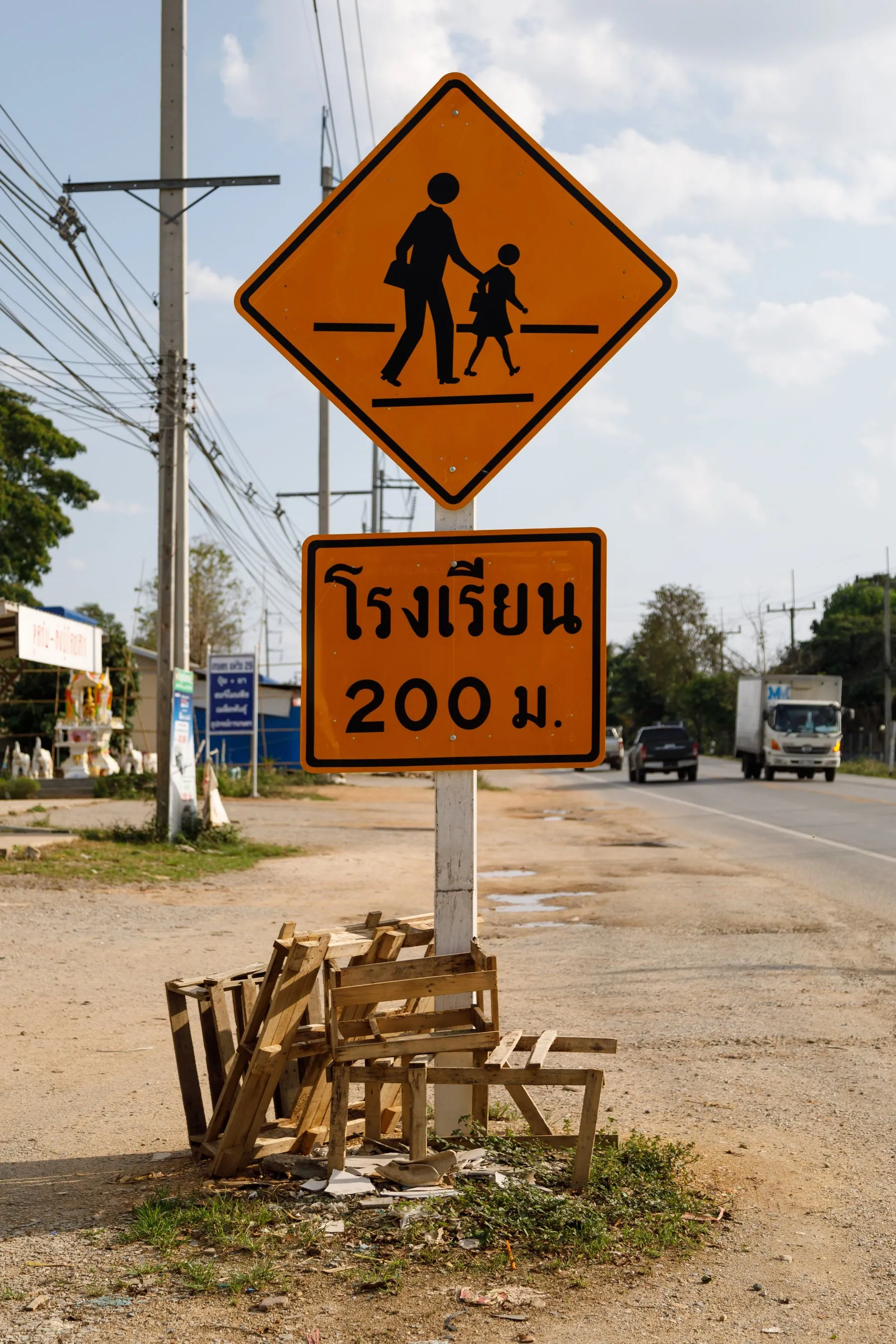
What drop-off actually looks like
The scene is the same across the country, from a Bangkok international school to a village primary in Isaan.
Vehicles stop in the live lane rather than pulling in, because there is nowhere to pull in. Motorbikes park at right angles to the kerb, projecting into the road. Parents on scooters carry two, three, occasionally four children, none of them helmeted. Children cross wherever they happen to be, often from behind a parked vehicle and often at a run. Vendors set up carts on the verge, which narrows the road and blocks sightlines. Songthaews and school minibuses stop and start with no signal. And somewhere in the middle of it a teacher or a volunteer may be directing traffic by hand.
The specific danger is a child emerging between stationary vehicles. A double-parked pickup gives a running child perfect cover until they are already in your path. On a road lined with stopped vehicles outside a school, your speed should be low enough that you can stop for something that appears from nowhere at two metres. That is walking pace, not 30 km/h.
Children on motorbikes
You will see children riding to school alone on scooters, well below any plausible licensing age, and children carried three-up behind a parent. Thailand's helmet law applies to riders and passengers of every age — section 122 makes it an offence for a rider to ride while a passenger is unhelmeted — and observed compliance among schoolchildren is poor.
None of that is your problem to solve at the roadside. It is your problem to anticipate. A child on a scooter has limited road sense, limited machine control and no ability to judge the closing speed of a car. Give them enormous room, pass slowly and widely, and do not use the horn close behind them — startling an inexperienced rider is how you cause the fall you were trying to avoid. Children on motorbikes in Thailand covers the wider picture, including what it means if you are travelling with your own.
Driving through a school zone: the technique
- Slow before the parked vehicles start, not once you are among them. By then your options are gone.
- Cover the brake the whole way through. Reaction time is the entire margin here.
- Do not overtake. Overtaking is prohibited within 30 metres of a pedestrian crossing under section 46, and a school gate almost always has one.
- Watch the gaps between parked vehicles, not the road ahead. That is where the movement will come from.
- Obey the crossing guard, including when the hand signal contradicts what the traffic is doing. They can see what you cannot.
- Do not stop in the live lane yourself, even briefly. You become the obstruction the next driver has to see round.
- Expect the vehicle in front to stop without warning. Following distance is the whole of your protection.
If you can plan around it, do. A journey that starts at 09:00 rather than 07:45, or at 14:00 rather than 15:30, avoids the problem entirely — and in a Thai town it also avoids the worst of the general traffic. On a long drive, check whether your route passes through village centres and time the run accordingly.
Enforcement
School zones are one of the places where Thai speed enforcement is genuinely concentrated. Mobile speed checks and static police posts appear near schools during term time, particularly on provincial highways where the limit drops from 90 km/h to something much lower for a few hundred metres.
The drop is often signed well before the buildings, and the check is often placed at the point where a driver who ignored the sign is still at highway speed. That is not a trap so much as sound placement, but it does mean the sign is worth taking seriously the moment you see it rather than when the school comes into view. Speed cameras in Thailand and how tickets find you explains how the enforcement works and how a ticket reaches a hire car weeks later.
Speeding carries a maximum of 4,000 baht since 2022. As with almost every penalty in the Act, that is a ceiling: the amount written on a roadside ticket is set by a Royal Thai Police schedule under section 140 and is normally well below the statutory maximum. Traffic fines in Thailand and what they cost explains how that works.
If you have children with you
Two separate points, both worth knowing before you set off.
A child under six travelling in a private car, pick-up or minivan must be in a child seat or a suitable specialised seat, and a passenger under 135 cm must use a seatbelt or a specialised seat. That requirement became operative on 17 August 2023 — not, as many sites still say, on 5 September 2022 — and the maximum penalty is 2,000 baht. Public vehicles including taxis and public vans are outside the rule entirely. The detail is in child car seats in Thailand.
And if you are riding rather than driving, understand what you are choosing. Thai families carry children on scooters as a matter of course; that is a statement about local circumstances, not a safety endorsement, and a child on the back of a rental scooter in traffic they cannot read is a different proposition from a child in a car. The biggest risk factors for visiting drivers puts it in context.
Frequently asked questions
What is the speed limit outside a school in Thailand?
Whatever is posted on the sign. Section 67 makes the posted limit binding, and section 70 separately requires you to slow on approach to junctions and crossings. Where no reduced limit is signed, the general limits apply — but the traffic outside a Thai school at drop-off makes those limits irrelevant anyway.
When are Thai school zones busiest?
Roughly 07:30 to 08:30 in the morning and 15:00 to 16:30 in the afternoon, term time. Individual schools vary, so treat the parked scooters as the real indicator rather than the clock.
Are school zones enforced in Thailand?
Yes, more than most limits. Mobile and static speed checks are concentrated near schools on provincial highways, usually placed where a driver who ignored the advance sign is still at highway speed.
Can I overtake in a school zone?
You should not, and section 46 prohibits overtaking within 30 metres of a pedestrian crossing, junction or traffic island — a school gate normally has at least one of those. Beyond the law, overtaking in a road full of children and double-parked vehicles is indefensible.
Why are there children riding scooters to school?
It is common practice in Thailand, particularly outside the cities, and the licensing and helmet rules are poorly observed among school-age riders. As a driver, your task is to anticipate it: give young riders wide berth, pass slowly, and do not use the horn close behind them.
Do I have to stop for a crossing guard?
Yes. Follow the hand signals, including where they seem to contradict the flow of traffic. Traffic volunteers appointed to assist officials have legal standing while performing those duties, and in any event they can see the situation better than you can.