Thai road signs follow international conventions closely enough that you will understand most of them on sight. Red-bordered triangles warn, red circles prohibit, blue circles instruct, blue and green rectangles inform. Where Thailand differs is not in the grammar of its signs but in three specific places: signs that carry Thai script and no English, signs for hazards that do not exist in Europe or North America, and the U-turn signs that govern how you actually get anywhere on a divided highway.
This page covers what you will see and what it means. For the specific problem of place names — which change spelling between one sign and the next — see reading road signs in Thai script without Thai.
The shapes and colours
| Shape and colour | Category | Examples |
|---|---|---|
| Red-bordered triangle, point up | Warning | Bend, crossroads, children, falling rocks, level crossing, slippery road |
| Red circle with white or blue field | Prohibition or restriction | No entry, no parking, no overtaking, speed limit, weight limit |
| Blue circle, white symbol | Mandatory instruction | Direction to be followed, minimum speed, compulsory lane |
| Blue rectangle | Information or facility | U-turn point, parking, hospital, petrol station, one-way arrow |
| Green rectangle | Directions and distances on highways | Destinations, route numbers, junction distances |
| Brown rectangle | Tourist and heritage destinations | Temples, national parks, historic sites, waterfalls |
| Octagon, red | Stop | Marked "หยุด" and often "STOP" |
Most highway direction signs on major routes carry both Thai and Roman script. Minor roads, town centres and supplementary plates frequently do not. The rule of thumb is that the bigger the road, the more English you get.
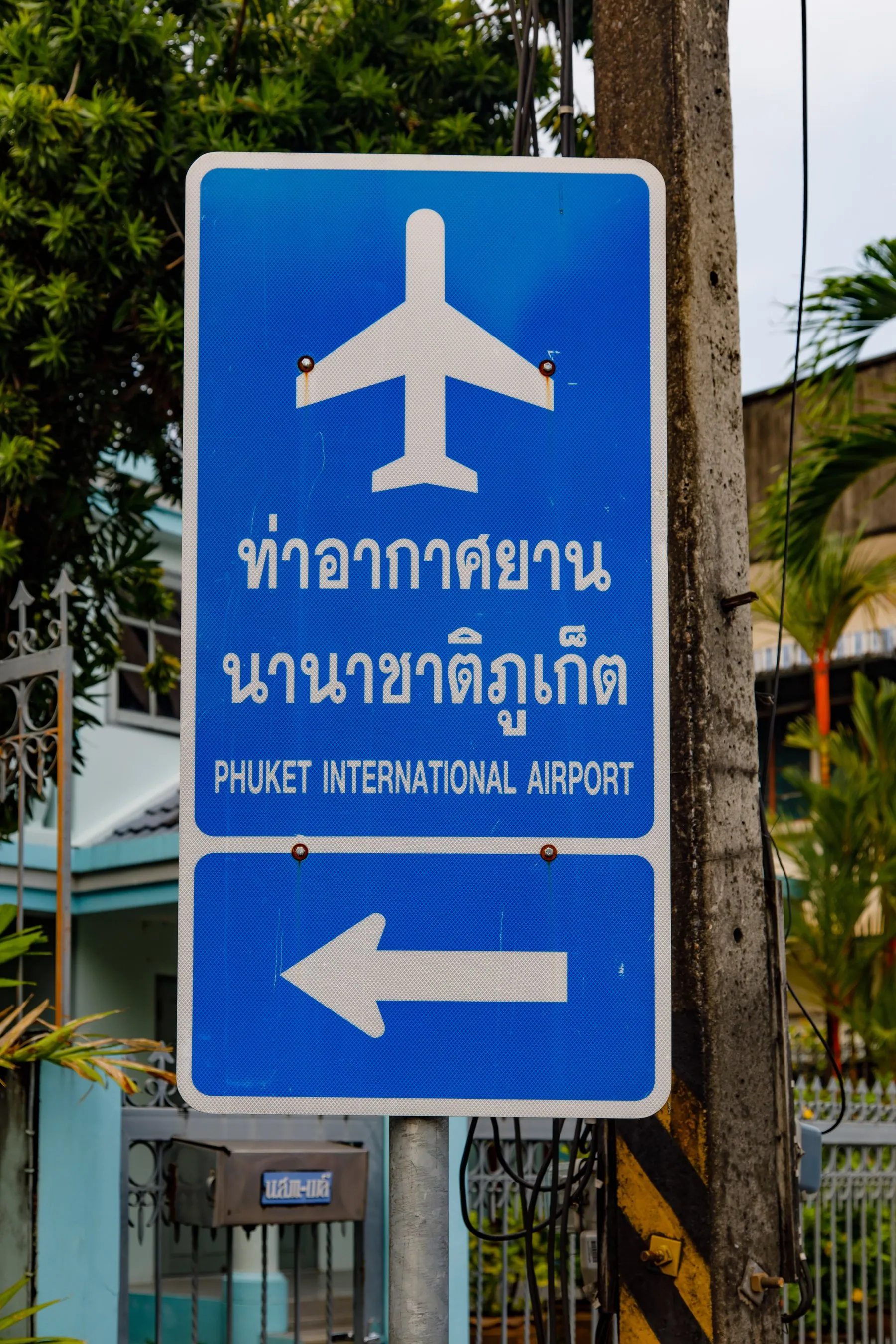
The signs a visitor must not misread
The U-turn sign. A curved arrow doubling back on itself, usually white on blue, often with a distance in metres. This is the sign that governs how you reach anything on the other side of a divided highway, because there is frequently no right turn at all. If you are looking for a turning that never comes, you are looking for the wrong thing — you want the U-turn slot. U-turns in Thailand is the page for this.
The no-U-turn sign. The same curved arrow with a red diagonal bar. Common at junctions and bridge approaches, where section 53 prohibits the manoeuvre anyway.
Speed limit versus minimum speed. A number in a red circle is a maximum. A number in a blue circle is a minimum. Minima are rare in Thailand but they exist — the outermost lane of a designated 120 km/h highway section carries a 100 km/h floor. See Thailand's 120 km/h highways.
No stopping versus no parking. A red circle with a single diagonal bar over blue means no parking. A red circle with a cross means no stopping at all. The kerb paint says the same thing in a different language, and it is covered in Thai road markings and kerb colours explained.
Supplementary plates are usually in Thai only. The plate under a sign is what restricts it by time of day, by date, by vehicle type or by distance — and it is the part you cannot read. If a prohibition seems not to be observed by anybody, the plate probably says it only applies at certain hours. Photograph it and translate it later rather than guessing.
Warning signs you will not have seen at home
Several Thai warning triangles have no equivalent in Europe or North America, and they are worth recognising because they warn of genuine hazards.
- Elephant. Real. In and around national parks — Khao Yai and Kui Buri especially — wild elephants use the road, mostly at dusk and after dark. This is not a decorative sign.
- Cattle or buffalo. Livestock on rural roads is routine, and animals are frequently unattended. See livestock and wildlife on Thai roads.
- Steep descent with a runaway lane. On northern mountain routes, escape lanes are provided for trucks that have lost their brakes. Do not park in one.
- Flooding. Used on roads that flood predictably in the rainy season, often with a depth gauge marked in metres beside the carriageway.
- Uneven surface and speed bump. Frequently posted where the bump itself is unpainted and invisible — see speed bumps and unmarked hazards on Thai roads.
- Motorcycles crossing or joining. Marks points where the shoulder traffic merges into the carriageway.
Highway direction signs
Green rectangular signs carry destinations, route numbers and distances. The route number is in a shield or box; the number of digits tells you what kind of road you are joining, which is genuinely useful information about what the surface and the traffic will be like. That system is explained in Thai highway numbers and distance signs decoded.
Distances are in kilometres. Kilometre posts along the highway show the distance from the road's origin, and they are how Thai authorities describe locations — the first 120 km/h section, for instance, was defined as "km 4+100 to km 50+000" of Highway 32. If you break down or have an accident, the nearest kilometre post is the most useful thing you can give an operator over the phone.
Note the kilometre post when you stop anywhere unplanned. "Highway 4, kilometre 218, southbound" locates you precisely for the police, an insurer or a recovery truck in a way that "about half an hour past a temple" does not. It is the single most useful habit on a long Thai drive — see what to do when you break down in Thailand.
Signs at checkpoints and roadworks
Police checkpoints are usually signed with cones and a portable sign, sometimes with an illuminated arrow, and are frequently placed just after a bend or a crest. Slow down when you see cones, and do not attempt to change lane late — see police checkpoints in Thailand.
Roadworks signing is variable and often minimal. It is entirely normal to meet a lane closure marked by a pile of branches or an old tyre, and excavations left open overnight with nothing but a stick and a plastic bag on it. Treat any unexplained obstruction as the start of unmarked works and slow down. Roadworks and unmarked hazards in Thailand covers what you will actually find.
What the sign means legally
What the law says
Section 67: a driver must drive at the speed set by ministerial regulation or by the sign on the road. A sign may set a maximum or a minimum, but may not set a maximum higher than the regulation.
Section 72 defines when a road counts as a main road for priority purposes, and does so partly by reference to signs: a traffic sign designating it as such, a stop or give-way sign on the joining road, a "Stop" marking on the surface, or a stop line or give-way line.
Section 53 prohibits a U-turn where a sign prohibits turning or reversing direction, and prohibits one at a junction unless a sign permits it.
In other words, the sign is not advisory. It sets the speed limit that binds you, it determines who has priority at a junction, and it decides where a U-turn is available. Where a sign and a general rule differ, the sign wins.
When there is no sign at all
This is common enough to plan for. Signs go missing, get obscured by vegetation, get knocked down and are not always replaced quickly. Where you have no sign:
Assume the general limits — 80 km/h for a car in a built-up area, 90 km/h outside one. Assume no priority at an unmarked junction, because section 72 requires a sign, marking or line for a main road to have priority, and where none is present the informal hierarchy takes over. And read the road: parked cars all facing one way means one-way; a line of scooters and children means a school.
Reading about signs is not the same as recognising one at 90km/h. Our Thai road sign quiz puts twenty of the ones that catch visitors out in front of you, with the answer explained each time. It takes about five minutes and it is a better use of them than re-reading this page.
Frequently asked questions
Are Thai road signs in English?
Major highway direction signs generally carry both Thai and Roman script. Warning and prohibition signs are symbol-based and need no language. Supplementary plates — the ones restricting a rule by time, date or vehicle type — are usually Thai only, and they are the ones you will actually want to read.
What does the curved arrow sign mean?
A U-turn point. On Thai divided highways there is often no right turn, so you drive past your destination to a signed U-turn slot and come back. With a red diagonal bar through it, the sign prohibits the U-turn instead.
Do Thai road signs use the same colours as Europe?
Broadly yes. Red-bordered triangles warn, red circles prohibit, blue circles instruct, blue rectangles inform, green rectangles give highway directions and brown rectangles point to tourist sites.
Are the elephant warning signs serious?
Yes. Wild elephants use roads in and around several national parks, particularly at dusk and after dark, and collisions happen. Slow down where the sign appears and do not stop to photograph an animal on the road.
What is the number in a blue circle?
A minimum speed, not a maximum. They are uncommon in Thailand — the main example is the 100 km/h floor in the outermost lane of a designated 120 km/h highway section.
What should I do if there is no speed limit sign?
Apply the general limits: for a car, 80 km/h in a built-up area and 90 km/h outside one. The detail is in speed limits in Thailand for every road type.