Away from the cities, Thai roads are shared with animals far bigger than dogs. Cattle and water buffalo are moved along and across rural roads twice a day. Monkeys colonise particular stretches of highway and have learned that stopped cars mean food. And in a handful of well-defined places, mostly where a road cuts through a national park, you can genuinely meet a wild elephant on the tarmac.
None of this is a reason not to drive in rural Thailand. It is a reason to know which animals appear where, how each of them moves, and what the correct response is — because the responses are not the same. What works with a buffalo will get you hurt with an elephant.
- Highest-risk hoursDawn and dusk, when herds are moved
- Most common large animalCattle, throughout rural Thailand
- Universal ruleBrake in a straight line; never swerve
Cattle and buffalo
This is the encounter you will actually have. Thai smallholders keep cattle — often the pale, humped Brahman-type animals — and, less commonly now, water buffalo. They are grazed on verges, in harvested paddy and on scrub land, and walked to and from that grazing along the road, usually by one person with a stick or on a motorbike, sometimes by nobody at all.
You will meet them most often in Isaan, where small farms and quiet straight roads make the ideal environment, but they are on rural roads throughout the country. Even the wide, fast Mittraphap highway has cattle grazing the central reservation and verges in places.
How they behave
Cattle move as a loose group and are herded from behind, which means the animals nearest you have nobody controlling them. They cross in a strung-out line rather than together, and there is almost always one more animal than you think — the last calf comes across thirty seconds after the rest, at a run, after you have decided the road is clear. Individual animals tethered on a long rope at the verge can suddenly swing into the road. Buffalo are slower, heavier and considerably less inclined to move for you, and are frequently near ditches, ponds and flooded paddy.
Count the herd, then wait for one more. The most common near-miss on a rural Thai road is accelerating away after the visible group has passed, straight into the last animal or the child bringing up the rear. When you see cattle, come to a near stop and stay stopped until you can see clear road on both verges.
- Slow early and substantially. Cattle react to engine noise by moving unpredictably, so approach quietly rather than braking hard at the last moment.
- Do not sound the horn at a herd. It scatters them, and a scattering herd is far more dangerous than a walking one.
- Pass on the far side of the road if it is clear, moving slowly and steadily rather than stopping alongside them.
- Look for the herder. If you can see the person, you can predict which way the animals are being pushed.
- On a motorbike, keep both feet on the bike and both hands on the bars.
A collision with a cow or buffalo is a serious crash, not a nuisance. These are animals of several hundred kilograms with a high centre of mass. A car hitting one at speed frequently takes the animal through the windscreen; on a motorbike it is potentially fatal. At night, a dark animal standing side-on to you is very nearly invisible until you are on top of it — one of the strongest arguments in driving at night in Thailand for finishing your distance before dark.
If you do hit livestock, the animal has an owner and the owner will want paying. This is normal and the conversation happens at the roadside. Do not leave, do not agree to a figure under pressure, and do get the police and your insurer's surveyor involved — what to do after a road accident in Thailand sets out the order, and it applies to an animal collision as much as to a car.
Monkeys
Long-tailed macaques live alongside people in dozens of places in Thailand, and several of those are on or beside roads. Lopburi is the famous one; there are large roadside troops at Prachuap Khiri Khan, around Khao Takiab in Hua Hin, at various temples and viewpoints, and along stretches of the road through Kanchanaburi and Highway 323.
Where there are monkeys there are signs, and where there are signs there are cars stopped at the roadside, people out of their vehicles, and children. The driving hazard is as much the human behaviour as the animals: expect a sudden queue, doors opening into the traffic lane, and someone reversing without looking. The monkeys themselves cross without warning, often with a straggler, and juveniles chase each other across at speed.
- Windows up and doors closed where troops are established.
- Do not feed them. Fed monkeys approach vehicles, which is how they get run over and how people get bitten.
- On a scooter, do not stop among them with luggage on the hooks or in the footwell.
- A monkey bite or scratch is a rabies exposure and needs medical attention the same day, exactly as a dog bite does.
Elephants
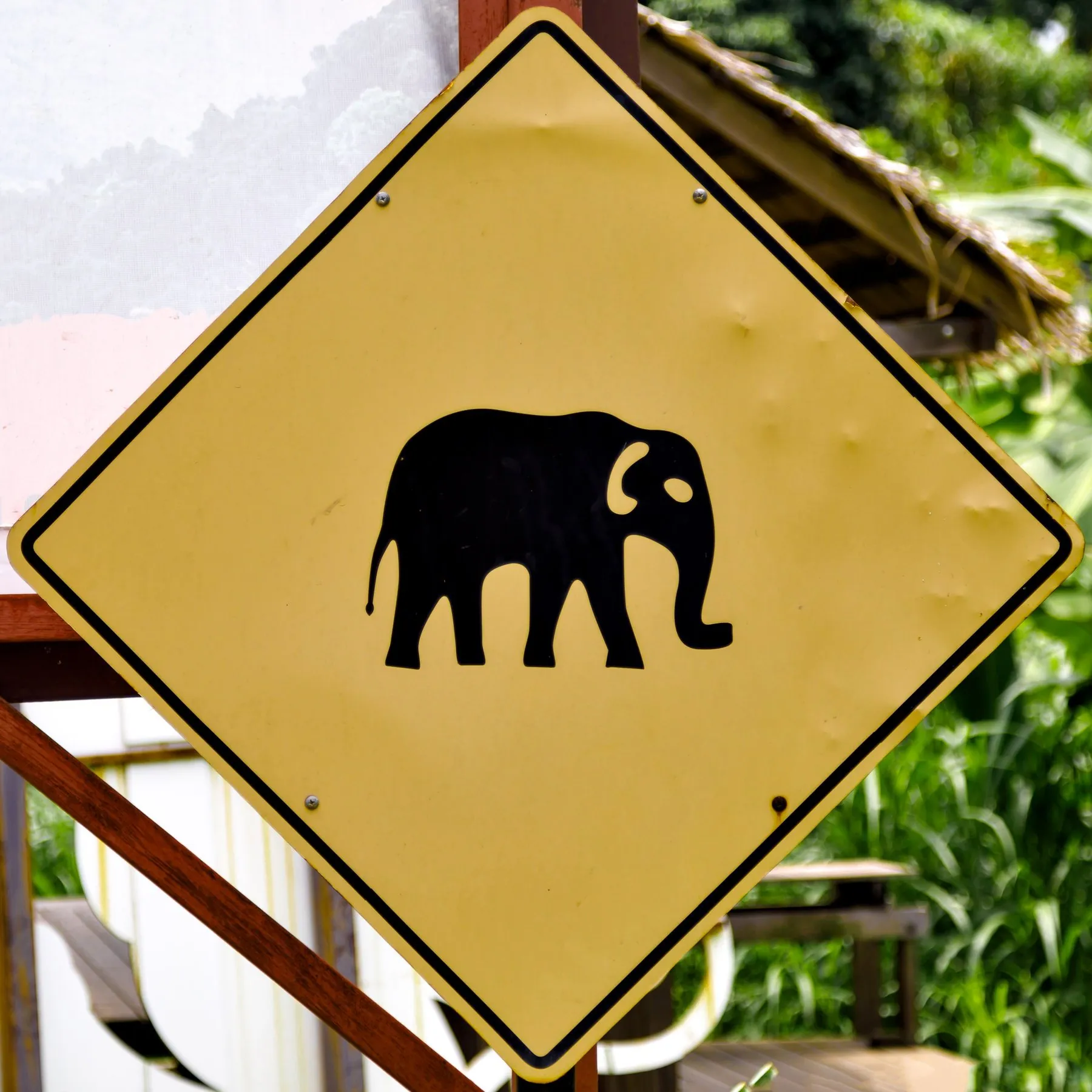
Two entirely different situations get confused here. Wild elephants live in protected forest and cross roads that cut through their range. The best-known conflict points are Highway 304 between Nakhon Ratchasima and Prachin Buri, where the road bisects the Dong Phayayen-Khao Yai forest complex and wildlife crossings have been built to reduce collisions; the park roads inside Khao Yai; the roads around Kui Buri and Kaeng Krachan in the west; and parts of the eastern forest in Chanthaburi and Sa Kaeo. They are most active at night and around dawn and dusk, and on an unlit road a dark grey animal three metres tall absorbs headlight rather than reflecting it.
If you meet a wild elephant, do not approach it, do not get out, and do not try to squeeze past. Stop well back — the length of a football pitch is not excessive — and switch off the engine and lights if the animal is agitated. Back away slowly if you can do so without turning round. Wild elephants have pushed vehicles off roads and killed people in Thailand, most often when a driver tried to get past or stopped to film. Wait, or go another way.
Working and tourist elephants are a separate matter: you will see them led along roads near camps and sanctuaries around Chiang Mai, Kanchanaburi, Surin and Ayutthaya. These are handled animals with a mahout and the risk is much lower, but the rules are the same — slow to walking pace, no horn, plenty of room, and do not pass close behind one.
Everything else
| Animal | Where | The specific risk |
|---|---|---|
| Goats | The far south, and dry rural areas | Move in tight groups, cross erratically, often unattended |
| Chickens and ducks | Villages everywhere | Harmless in themselves; the swerve to avoid one is not |
| Snakes | Rural roads, warm evenings, after rain | Lie on warm tarmac; a large one is a genuine obstacle on a scooter |
| Monitor lizards | Near water, canals, parks | Large, slow and surprisingly solid |
| Deer and wild pig | Forest roads, northern hills, national parks | Bolt across at dusk; wild pig come in family groups |
The one rule that covers all of it
Brake in a straight line and hold your line. Every one of these encounters ends badly for the same reason: the driver swerves, and hits something worse than the animal. On a motorbike a swerve at speed loses the front wheel; in a car it puts you into the oncoming lane or off the edge of a road that frequently has a deep drainage ditch rather than a verge.
The second rule is that speed is the only variable you fully control. On a rural road at dawn or dusk, with livestock or forest either side, a moderate speed turns a potential collision into a stop with room to spare. There is no technique that substitutes for it.
Frequently asked questions
How likely am I actually to meet an elephant?
On a normal itinerary of highways and towns, very unlikely. If your route includes Highway 304, the park roads of Khao Yai, or the western forest roads around Kui Buri after dark, it stops being unlikely. The signs on those roads are not decorative.
What do I do if cattle are blocking the whole road?
Stop and wait. Herders move animals off the carriageway as quickly as they can and it rarely takes more than a minute or two. Edging through the middle of a herd is how a startled animal ends up against your door.
Who pays if I hit someone's cow?
In practice it is negotiated between you, the owner and the insurers, with the police recording what happened. Third-party liability cover generally responds to damage you cause to someone else's property, which includes livestock, but the details depend on your policy. Do not settle a large sum at the roadside without your insurer involved.
Does a horn help?
Rarely, and often the reverse. A light tap from a distance may move an animal that has not noticed you. A long blast close up scatters a herd, panics a monkey troop and agitates an elephant. Slowing down does more good than any noise you can make.