The problem with Thai road signs is not that they are in Thai. Most highway direction signs carry Roman letters too. The problem is that the Roman spelling is not standardised, so the same town appears as three different words on three consecutive signs, and the one you memorised from your booking confirmation matches none of them.
The fix is to stop reading the letters and start matching the shapes. You do not need to learn Thai, or even to learn the alphabet. You need to be able to recognise five or six written words by their outline, the way you recognise a logo. That takes about ten minutes and it will save you a great many wrong turnings.
Why the transliteration is unreliable
Thai has sounds and tones that Roman letters do not represent, and there is no single official romanisation in universal use on signs. Different agencies, different eras and different sign contractors have made different choices.
So you will meet:
| Place | Spellings you will actually see |
|---|---|
| Ubon Ratchathani | Ubon Ratchathani, Ubol Rajathani, Ubonratchathani |
| Ayutthaya | Ayutthaya, Ayudhya, Ayuthaya, Phra Nakhon Si Ayutthaya |
| Koh Samui | Koh Samui, Ko Samui, Kho Samui |
| Chonburi | Chonburi, Chon Buri, Cholburi |
| Bangkok | Bangkok, Krung Thep, and on many signs กรุงเทพฯ alone |
That last one catches people out badly. Bangkok's Thai name is Krung Thep, and a substantial number of signs — particularly older ones and those aimed at local traffic — give only the Thai. A driver looking for the word "Bangkok" can pass several correct signs without recognising any of them.
Before you set off, put your destination into a mapping app and screenshot the Thai name. You now have a picture to match against the sign, and matching a picture is far easier and far more reliable than matching an unfamiliar transliteration at 90 km/h.
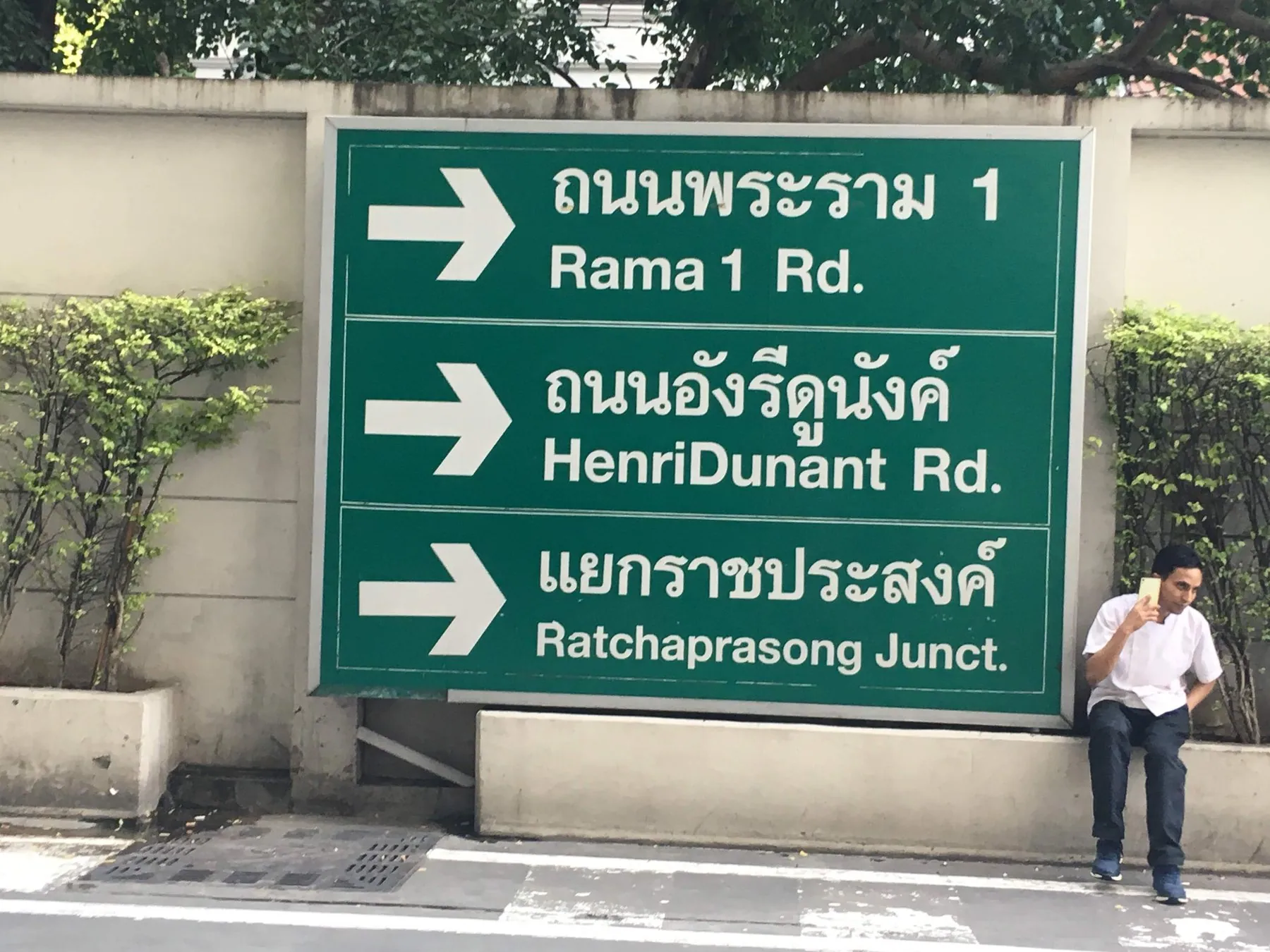
The words worth recognising
You are matching shapes, not reading. Print or screenshot these.
| Thai | Means | Where it appears |
|---|---|---|
| หยุด | Stop | Stop signs and painted on the road surface |
| ทางออก | Exit / way out | Motorway exits, car parks, ferry terminals |
| จุดกลับรถ | U-turn point | The sign you will need constantly on divided highways |
| ทางเบี่ยง | Diversion | Roadworks. The road ahead is closed or rerouted |
| ระวัง | Caution | Warning signs of every kind |
| โรงพยาบาล | Hospital | Blue facility signs. Worth knowing for obvious reasons |
| สถานีตำรวจ | Police station | Where a handwritten ticket may have to be paid |
| ปั๊มน้ำมัน | Petrol station | Though the brand logos are usually easier to spot |
| กรุงเทพฯ | Bangkok | Everywhere. Learn this one first |
| เชียงใหม่ | Chiang Mai | All northern routes |
| ภูเก็ต | Phuket | All southern routes |
Four more that turn up inside place names and tell you what kind of place it is: ถนน (road), ซอย (soi, a side street), เกาะ (island, romanised Koh or Ko) and หาด (beach, romanised Hat or Haad). วัด is temple, romanised Wat, and appears on a great many brown tourist signs.
Thai numerals
Most road signs use Arabic numerals for distances, speeds and route numbers, so you will rarely be stuck. Thai numerals do appear — on supplementary plates restricting a rule by date or time, on some parking signs, and on older signage.
| Thai | ๐ | ๑ | ๒ | ๓ | ๔ | ๕ | ๖ | ๗ | ๘ | ๙ |
|---|---|---|---|---|---|---|---|---|---|---|
| Value | 0 | 1 | 2 | 3 | 4 | 5 | 6 | 7 | 8 | 9 |
The one to be careful with is ๕, which is five and looks nothing like one. Where you meet Thai numerals it is usually on the plate under a parking or one-way sign — the part that restricts the prohibition by date, which is exactly the part you want to understand. Parking rules in Thailand covers the odd-and-even date system those plates express.
Using a phone to read a sign
Google Translate's camera mode reads Thai script reasonably well and works offline if you download the Thai language pack before you travel. Download it at the hotel, not at the roadside.
Two rules for using it. First, never point a phone at a sign while moving — pull over properly, off the carriageway. Second, treat the output as indicative. Machine translation of a short sign or a supplementary plate is frequently garbled, and a plate about parking dates or vehicle-type restrictions is exactly the kind of terse text it handles worst. If the translation makes no sense, the safe interpretation is the restrictive one.
Supplementary plates are the ones that matter and the ones that are Thai-only. The main sign tells you a prohibition exists. The plate below tells you when it applies, to whom, and for how far. A no-parking sign with a plate you cannot read is not an invitation to guess — photograph it, and if you need to be sure, park somewhere else.
Navigating without reading anything
The signs are a backup. The primary technique in Thailand is the route number, and it works because the numbers are Arabic and unambiguous.
Know the number of the road you want and follow it. Signs give the number in a shield or box alongside the destination, so you can confirm you are on Route 4 without being able to read a word. The digit count also tells you what kind of road it is — one digit is a trunk route, four digits is a local lane — which is set out in Thai highway numbers and distance signs decoded.
Kilometre posts do the same job for position. Note the post number where you stop and you can tell anybody exactly where you are without a word of Thai, which matters most on the day something goes wrong. What to do when you break down in Thailand covers why.
And on the warning and prohibition signs, the symbols carry the meaning without language at all — the shapes and colours follow international convention, as Thai road signs explained sets out.
A workable system
- Screenshot the Thai name of your destination before you leave.
- Write down the route numbers for the journey, in order, and keep them visible.
- Download the offline Thai language pack for your translation app.
- Save the map area offline too — mobile coverage is good in Thailand but not universal in the mountains and along parts of the coast. Navigation apps in Thailand covers which apps handle this best.
- Learn to recognise จุดกลับรถ, the U-turn point. On a divided highway it is how you reach anything on the other side, and you will want it repeatedly — see U-turns in Thailand.
- Do not read signs while driving. If you need to work out what a sign means, stop somewhere safe first.
Frequently asked questions
Are Thai road signs in English?
Major highway direction signs generally carry both Thai and Roman script. Town centres, minor roads and supplementary plates frequently do not. Warning and prohibition signs are symbol-based and need no language at all.
Why does the same town have different spellings on different signs?
Because Thai romanisation is not standardised, and different agencies and eras made different choices. Ubon Ratchathani, Ubol Rajathani and Ubonratchathani are the same place. Match the Thai script or the route number instead.
Why do some signs say Krung Thep instead of Bangkok?
Krung Thep is the Thai name for the city, and many signs give only that or only the Thai script กรุงเทพฯ. If you are looking for the word "Bangkok" you will miss correct signs. It is the single most useful piece of Thai script to be able to recognise.
Do I need to learn the Thai alphabet?
No. You need to recognise five or six written words by their shape, the way you recognise a logo. Screenshot them before you travel and treat them as pictures.
Can I use Google Translate on Thai road signs?
Yes, with the camera mode and the Thai language pack downloaded for offline use. Download it before you travel, never use it while moving, and treat short supplementary plates with suspicion — machine translation handles terse signage poorly.
What are the Thai numerals?
๐ ๑ ๒ ๓ ๔ ๕ ๖ ๗ ๘ ๙ for 0 to 9. Most road signs use Arabic numerals, but Thai numerals appear on supplementary plates restricting parking and other prohibitions by date — which is exactly where you want to be able to read them.