Thai road signs are mostly international, which is exactly what makes the local ones dangerous: you read ninety per cent of them without thinking, and then the tenth one is a painted kerb, a blue disc with a number in it, or a plate of Thai script that quietly reverses the sign above it.
Twenty signs and markings below, drawn rather than photographed so the shapes and colours are exact. Pick an answer and you get the reasoning straight away. Nothing is saved and nothing is sent anywhere.
Twenty signs
The four that catch people out
If you take nothing else from the quiz, take these. They are the ones where a visitor reads the sign confidently and reads it wrong.
Painted kerbs are not decoration. Red and white means no stopping at all; yellow and white means no parking but a brief set-down is fine; black and white means park here, close in. There is no sign on a post to back any of it up, which is why a hire car in Bangkok gets clamped. The detail is in Thai road markings and kerb colours.
Blue means motorway, not services. Direction signs on the ordinary national highway network are green; the tolled motorway and expressway network is blue. That is the reverse of the American convention and it means a blue sign is telling you about tolls, no U-turns, no stopping and — for anyone on two wheels — a road you are banned from. See expressways and motorways.
A blue disc with a number is a minimum, not a maximum. Maximum speed limits are white discs with a red rim. Blue circles in Thailand give orders, and a blue disc with a number in it is telling you not to go slower than that. It bites on the divided highways signed for 120 km/h, where the outermost lane carries a minimum of 100 km/h. All of it is in speed limits in Thailand.
The small white plate under a sign is the actual rule. Times, days, odd or even dates, or the word ยกเว้น — "except" — followed by the vehicles the ban does not apply to. If you cannot read the plate, obey the sign above it without exception. Reading road signs in Thai script covers the handful of words worth recognising.
Why the U-turn signs deserve their own paragraph
Thai divided highways generally do not let you turn right across the carriageway. You drive past your destination, take a signposted U-turn slot — a tall blue plate with a white U-shaped arrow — and come back. Some of those slots are bridges or underpasses and are entirely benign. The ones that hurt people are at grade, with no signals and no acceleration lane, so you pull out across two or three lanes of hundred-kilometre-an-hour traffic from a standing start. Knowing which sign is the permission and which is the prohibition is worth more here than almost anywhere else you will drive. U-turns in Thailand has the law and the reality.
How much of this actually matters at the roadside
Honestly: less than the signs themselves suggest, and more than the traffic around you implies. Thai enforcement is concentrated at static checkpoints and on a handful of offences, and you will watch riders go the wrong way under a no-entry sign all day without consequence. But the signs still describe the road, and the road does not care about enforcement. A double solid yellow line is on a blind bend because overtaking there kills people, not because a police officer is watching. Thai road signs explained is the full reference, and highway numbers and distance signs covers the numbering scheme the quiz only touches.
Every shape, colour and Thai word drawn above was checked against Thai sign catalogues and Department of Highways standards before it went in — the sources are listed at the foot of this page. There were more candidates than twenty. The ones that did not make it, including a couple of signs whose meaning could not be pinned down from a source we trust, were left out rather than guessed at.
Save the emergency numbers card to your phone before you drive. It takes a minute now and it is the one page on this site you would rather not have to search for one-handed.
Are Thai road signs in English?
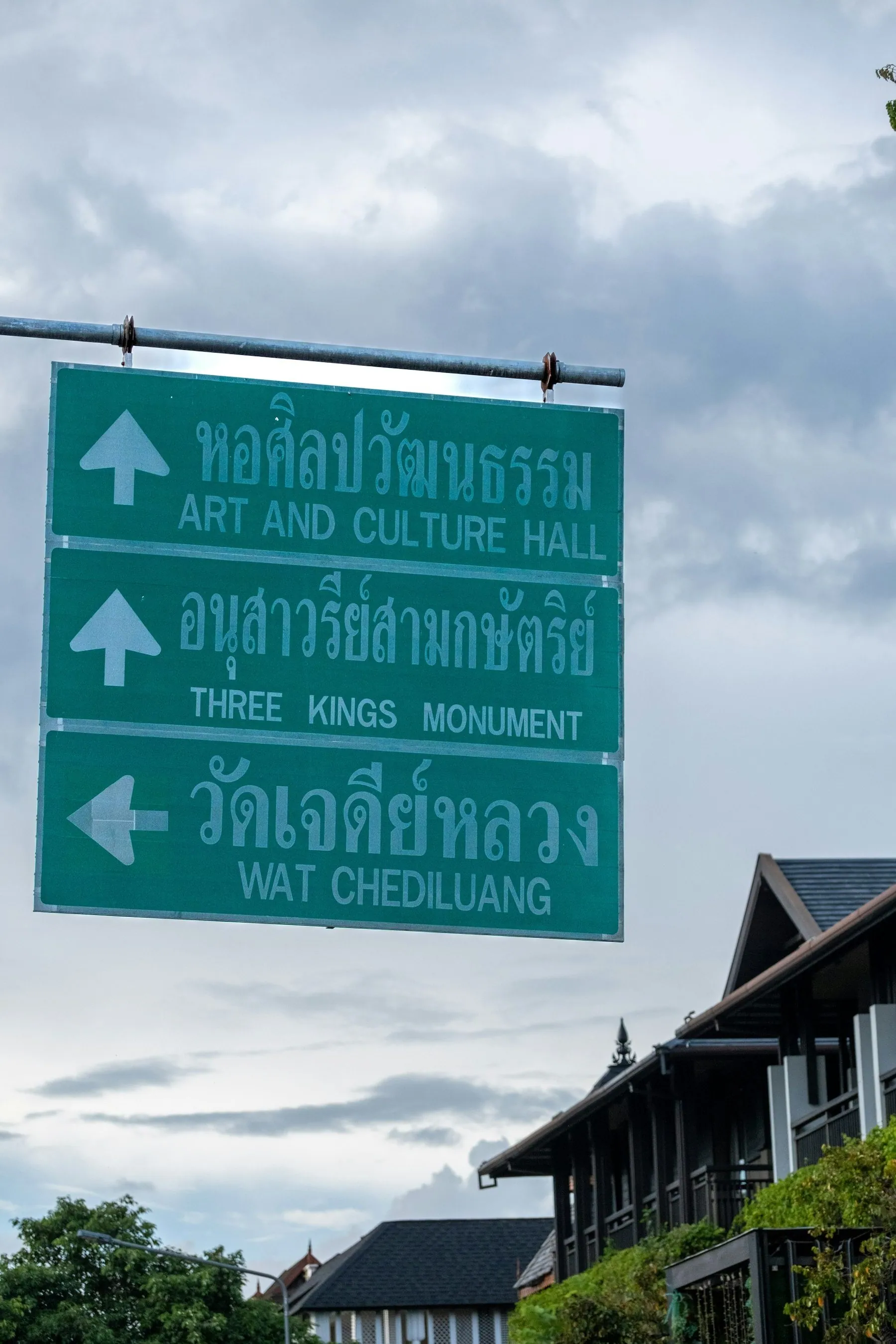
Many are bilingual, especially direction signs on the main highway network and in tourist provinces. Regulatory signs are often Thai only, and supplementary plates almost always are. The shapes and colours do the heavy lifting: an eight-sided red sign means stop whether or not you can read the word on it.
What does a blue road sign mean in Thailand?
Two different things, depending on its shape. A large blue rectangular direction sign means the tolled motorway and expressway network, where green means the ordinary national highway network. A small blue circle is an instruction you must follow rather than a prohibition — keep left, minimum speed, motorcycle lane. See expressways and motorways.
Do I need to know any Thai to read the signs?
Not much, but a few words repay the effort — หยุด (stop), ให้ทาง (give way) and ยกเว้น (except) are the three that change what you should do. See reading road signs in Thai script.
What happens if I get a sign wrong and a camera catches it?
The notice goes to the registered owner of the vehicle, which for a hire car means the rental company, which will pass the fine to your card with an administration fee. Traffic fines in Thailand explains what the law allows and why almost every figure you see quoted online is a maximum rather than a price.
Is a sign here the same as an enforced rule?
Not reliably, and we would rather say so than pretend otherwise. Write the rule down and then look at the road: motorcycles are supposed to keep to the left-hand lane and they do not, one-way streets are treated as advisory by local riders, and helmet law is absolute in the text and patchy at the roadside. Drive to the signs anyway — the other traffic will not, and that is the situation you have to survive.