Almost every traffic penalty in Thai law is written as a ceiling, not a price. The Land Traffic Act says "a fine not exceeding 2,000 baht", and the figure actually written on a roadside ticket comes from a separate schedule issued by the Commissioner-General of the Royal Thai Police under section 140 — a schedule that sets the routine amounts far below the statutory maximum. So the honest answer to "what does no helmet cost in Thailand?" is: the law allows up to 2,000 baht, and a routine ticket is normally well below that.
That is an unsatisfying answer, and it is the reason so many websites give a confident number instead. We are not going to. The fixed-penalty schedule is not published in a form we could retrieve and check, and every specific figure in circulation online traces back to rental shops, forum posts and travel blogs rather than to the police. What we can give you is the ceiling for every offence a visitor is likely to meet, which is genuinely useful, because it tells you which mistakes are trivial and which are not.
- How penalties are writtenMaximums, not fixed amounts
- Who sets the ticket amountA Royal Thai Police schedule under s.140
- Time to payNormally 7 days from receiving the ticket
- Not fixed-penalty offencesDrink-driving, drug-driving, racing, failing to stop after a crash
Why the maximum and the ticket are different numbers
The Land Traffic Act (No. 13), in force from 5 September 2022, quadrupled a long list of statutory ceilings. Speeding went from a maximum of 1,000 baht to a maximum of 4,000. Riding without a helmet went from 500 to 2,000. Not wearing a seatbelt went the same way. This was widely reported at the time in Thai media as a largely symbolic change, on the straightforward ground that enforcement capacity did not increase alongside it.
What the amendment did not do was change the mechanism. Section 140 still gives the officer two choices — a warning, or a ticket for "a determined penalty fine" set according to criteria prescribed by the Commissioner-General. The ceiling matters when a case goes in front of a court, or when an officer writes a ticket at the top of the range for something egregious. It is not the number on a routine slip for a missing helmet.
What the law says
Section 140. Where a traffic officer finds a breach of the Act, whether in person or by using any device, the officer may give a warning or issue a traffic ticket requiring the payment of a determined penalty fine. The determination of that fine follows criteria prescribed by the Commissioner-General of the Royal Thai Police.
Section 141. The recipient pays the amount stated on the ticket, at the place stated on the ticket or a place gazetted by the Commissioner-General, within the time stated. On payment, the case is deemed settled.
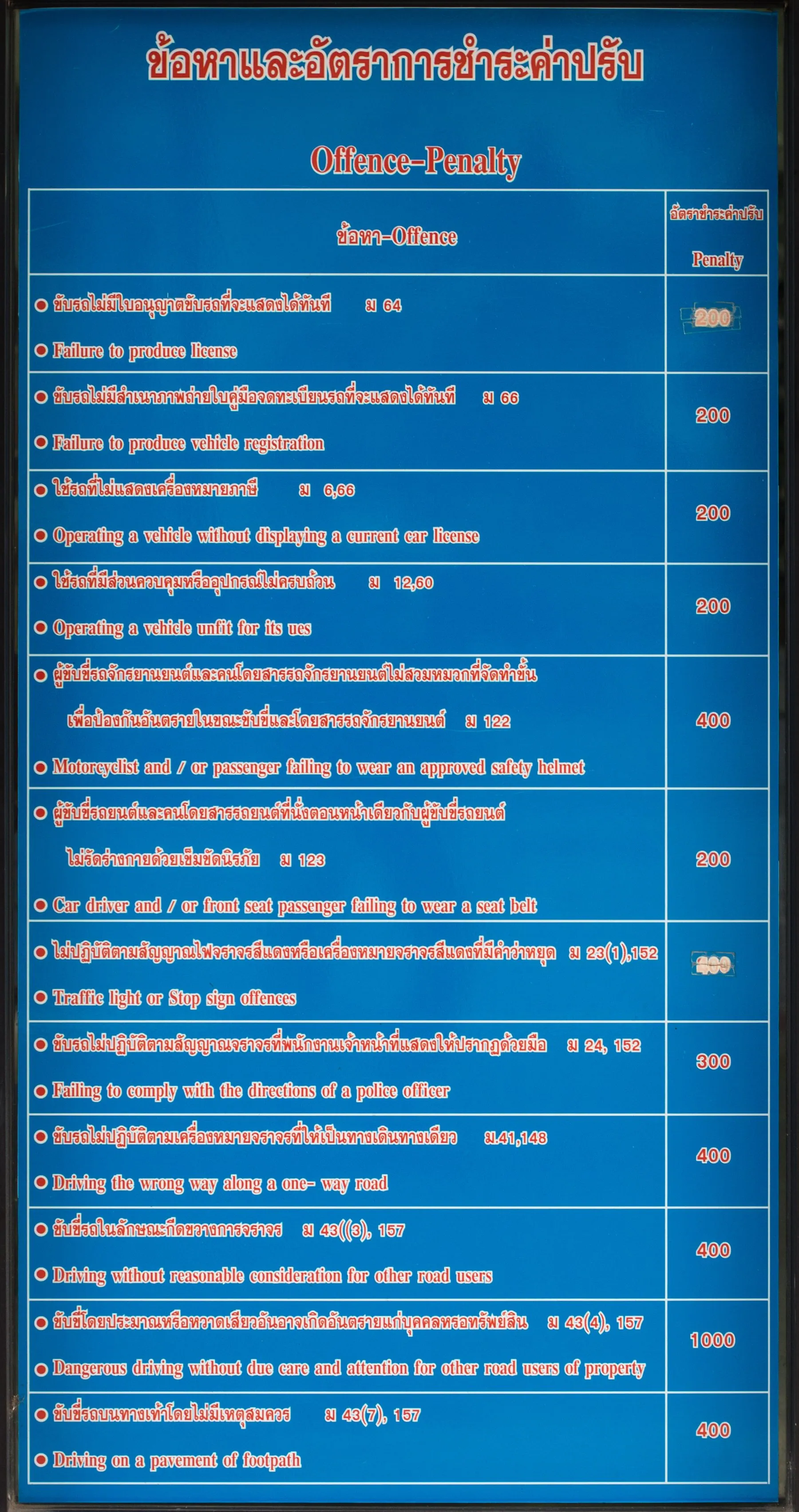
The everyday offences and what the law allows
These are the ones a visitor collects. All figures are statutory maximums. Where a range like "400–1,000 baht" appears, that is a range written into the Act itself.
| Offence | Maximum the law allows | Where it comes from |
|---|---|---|
| Speeding | Up to 4,000 baht | Act No. 13, from 5 Sept 2022 (previously 1,000 under s.152) |
| Running a red light | Up to 4,000 baht | Act No. 13 |
| Failing to stop for a pedestrian at a crossing | Up to 4,000 baht | Act No. 13 |
| Using a hand-held phone while driving | 400–1,000 baht under s.157; the Royal Thai Police put the maximum at 4,000 baht in their April 2026 enforcement campaign | s.157 / RTP announcement |
| Driving against the flow of traffic | Up to 2,000 baht | Act No. 13 |
| No crash helmet, rider or passenger | Up to 2,000 baht | Act No. 13 (previously 500 under s.148) |
| No seatbelt | Up to 2,000 baht, for the driver and for each passenger | Act No. 13 |
| Child under 6 with no child restraint | Up to 2,000 baht | Act No. 13; operative from 17 Aug 2023 |
| Riding a motorcycle on an expressway or motorway | Up to 1,000 baht | Prohibited at every engine size |
| Illegal overtaking, wrong lane use, illegal U-turn | 400–1,000 baht | s.157 |
| Not keeping to the left / lane misuse under ss.33–34 | 200–500 baht | s.151 |
| Failing to stop when ordered, or refusing a test | Up to 1,000 baht each time | s.154 |
| Obstructed view / driver cannot see the road clearly | Up to 500 baht | ss.8 and 124, via s.148 |
| Cyclist offences under ss.79–83 | Up to 200 baht | s.147 |
Licence offences, which sit in a different Act
Driving without a licence is not a Land Traffic Act offence at all — it lives in the Motor Vehicle Act, which is why the 2022 increases did not touch it. The figures below come from translations we could not check against the current Royal Gazette text, so treat them as approximate ceilings rather than precise current maximums.
| Offence | Maximum |
|---|---|
| Driving or riding without a driving licence | Up to 1 month's imprisonment and/or a fine of up to about 1,000 baht |
| Driving on an expired, suspended or revoked licence | Fine of up to about 2,000 baht |
| Failing to produce your licence on demand | Fine of up to about 1,000 baht |
| Driving while suspended under the points system | Up to 3 months and/or up to 10,000 baht |
| No compulsory insurance (Por Ror Bor) on the vehicle | Fine of up to 10,000 baht |
For a visitor, the fine is rarely the expensive part. A thousand baht is roughly £23 / US$30 / €26 — an irritation. Riding without the correct licence category can put you outside your travel insurance altogether, and the UK government says so in plain terms in its Thailand advice. A serious motorcycle injury here means a private hospital and possibly an air ambulance. Read what voids your motorbike cover in Thailand before you decide the ticket is the whole cost.
The offences that are not tickets at all
Section 140 expressly excludes a group of offences from the warning-and-ticket system. These cannot be settled at the roadside or over a shop counter; they go to an investigating officer and then to a court, which can also suspend or revoke a licence.
| Offence | Penalty |
|---|---|
| Drink-driving, first offence | Up to 1 year and/or 5,000–20,000 baht, plus the court must suspend the licence for at least 6 months or revoke it |
| Drink-driving causing injury | 1–5 years and 20,000–100,000 baht; suspension of at least 1 year or revocation |
| Drink-driving causing serious injury | 2–6 years and 40,000–120,000 baht; suspension of at least 2 years or revocation |
| Drink-driving causing death | 3–10 years and 60,000–200,000 baht; revocation is mandatory |
| A second drink-driving offence within two years | Up to 2 years and/or 50,000–100,000 baht |
| Driving under the influence of narcotics | One third more than the penalty under the narcotics law, plus suspension of at least 6 months or revocation |
| Refusing a drug examination | Up to 1,000 baht, plus detention until the examination is completed |
| Reckless driving / driving without regard for the safety of others | Up to 1 year and/or 5,000–20,000 baht |
| Failing to stop and assist after a collision | Up to 3 months and/or 2,000–10,000 baht; up to 6 months and 5,000–20,000 baht where serious injury or death results |
| Taking part in an illegal street race | Up to 3 months and/or 5,000–10,000 baht |
| Organising, supporting or advertising a street race | Up to 6 months and/or 10,000–20,000 baht |
One curiosity from the 2022 amendment that is genuinely reported and worth knowing about, though we have it from a single Thai newspaper rather than from the statute: driving through standing water in a way that splashes people is said to carry a maximum of 10,000 baht. In a country with the rainy season Thailand has, that is not a hypothetical.
The 2026 enforcement drive
From 1 April 2026 the Royal Thai Police Traffic Management Centre named ten offences for strict enforcement: speeding, running a red light, failing to stop for pedestrians, mobile phone use, wrong-way driving, no helmet, no seatbelt, no licence, driving under the influence and reckless driving. Seven of those ten are things a visitor on a rented scooter can do without thinking about it.
This matters because the 2022 fine increases arrived without a corresponding change in how much enforcement actually happened. The April 2026 campaign is the first sustained push we have a dated official announcement for, and it runs alongside the new link between unpaid fines and the vehicle tax disc that began on 1 August 2026. Whether that changes the day-to-day experience of driving here is not something anyone can honestly assert yet.
What you will actually be asked to pay
Travellers consistently describe three-figure amounts for the everyday offences — the helmet, the licence, the illegal turn — rather than anything near the ceilings above. That is the pattern, it is reported very widely, and it is consistent with how a fixed-penalty schedule under section 140 is designed to work. We are not printing a figure for any individual offence, because the schedule itself is not something we could obtain and verify, and a made-up number in an article like this one is worse than no number at all.
What you can rely on is the shape of it. Everyday moving and equipment offences are cheap in absolute terms. Court offences are not, and they carry consequences that outlast the money. If you want to check a ticket you have actually been given, the amount is written on it, and the fine lookup walks through reading it.
The ticket is the receipt trail. A lawful penalty produces paperwork at both ends: a numbered ticket handed to you, and a payment record afterwards. What a legitimate Thai police receipt looks like is the single most useful thing to have read before you are ever stopped.
Fines on a hire car or a rented bike
Camera-generated tickets are issued against the vehicle, not the driver, and section 140 makes the registered owner presumed liable unless they prove someone else was driving. On a hire car, that is the rental company. They will identify you as the driver, pay or pass on the fine, and charge it to the card on file under the rental agreement — usually with an administration fee on top, and often weeks after you have flown home. Speed cameras in Thailand and how tickets find you explains the chain, and credit card holds on Thai car rentals covers what the company can take and when.
On a rented motorbike the mechanism is usually cruder: the shop holds a cash deposit, and a ticket you leave unpaid comes out of it. That is one of several reasons the rental deposit is worth understanding before you hand any money over.
Frequently asked questions
How much is the fine for riding without a helmet in Thailand?
The law allows up to 2,000 baht. The amount on an actual ticket is set by a police schedule and is normally well below that; travellers routinely describe three-figure sums. We do not publish a specific figure because the schedule is not something we have been able to obtain and verify.
Why does every other website give a precise number and you do not?
Because those numbers overwhelmingly come from rental shops, forums and other travel sites rather than from the police, and they have been copied between sites for years without anyone checking them. The statutory maximums in this article come from the Act and from Thai national press reporting the 2022 amendment; the fixed-penalty schedule does not.
Can I pay a fine on the spot to the officer?
No. The lawful process is a ticket, paid later at one of the official channels — a bank, a convenience store, a post office, the station named on the ticket, or online. There is no roadside cash payment in the Act. See how to pay a traffic fine in Thailand.
Does a Thai traffic fine follow me home?
For a two-week visitor on a hired scooter, an unpaid ticket is very unlikely to reach you abroad — the enforcement chain runs through the vehicle and its registered owner, not through your passport. The practical consequence usually lands on the rental deposit or the card on file instead. Unpaid traffic fines in Thailand sets out what actually happens.
Are the fines higher for foreigners?
Not in law. The schedule under section 140 attaches to the offence, not to the driver's nationality. Foreign drivers do report being stopped more often in tourist areas, which is a different thing and is not something we can source to any official document.
Do fines come with points on my licence?
Thailand has run a demerit points system since January 2023, but it is built around the Thai licence and the police ticket database. A visitor driving on a foreign licence and an IDP has no Thai licence record for points to be deducted from. The points system explains what is and is not established about that.
What if I think the ticket is wrong?
The roadside is not where that is decided. The ticket names a station and a deadline; raising it there, or through the Police Ticket Management system, is the route. Paying settles the case under section 141, so pay only once you are content to close it.