Search the offence and you get what Thai law allows, where that figure comes from, and how much confidence it deserves. Most sites give you a single confident number. Almost all of those numbers are wrong in the same way, and it is worth understanding why before you use this.
Almost every Thai traffic fine is a maximum, not a price
The Land Traffic Act sets penalties as "a fine not exceeding X". What actually gets written on a roadside ticket is set by a schedule the Commissioner-General of the Royal Thai Police issues under section 140, and it is normally far below the statutory ceiling.
So a figure here of "up to 2,000 baht" does not mean you will be asked for 2,000 baht. It means no more than that can lawfully be imposed for it. We could not obtain the current fixed-penalty schedule, so this tool does not pretend to know what any individual ticket will say — and neither does any site that quotes you a precise on-the-spot figure.
Look up an offence
How to read the "basis" line
Every entry says where its number comes from, because that turns out to matter:
- Act 1979 — the penalty is in the Land Traffic Act B.E. 2522 itself, and we cite the section. These are the most reliable.
- Act No. 13 (2022) — a raised maximum introduced by the amendment in force from 5 September 2022. The Royal Gazette PDFs returned an error to every attempt to fetch them, so these come from consistent reporting of the amendment rather than from the statute text.
- RTP announcement — a figure the Royal Thai Police published in an enforcement campaign, which in at least one case sits well above the penalty in the Act. Where that is so, both are shown.
Three things this tool deliberately will not tell you
A fixed roadside amount. The police fixed-penalty schedule was not obtainable. Anyone quoting you "500 baht for no helmet, on the spot" is repeating forum lore.
A window-tint percentage. There is no confirmable current legal limit on window tint in Thailand — see the full explanation. The widely cited "40%" traces back to a rule announced in 2000 whose enforcement was postponed, and from there to tint-shop marketing.
A per-offence demerit points table. Sources contradict each other on which offence costs how many points. Only the structure is reliably reported — see the points system.
What to do when you are actually stopped
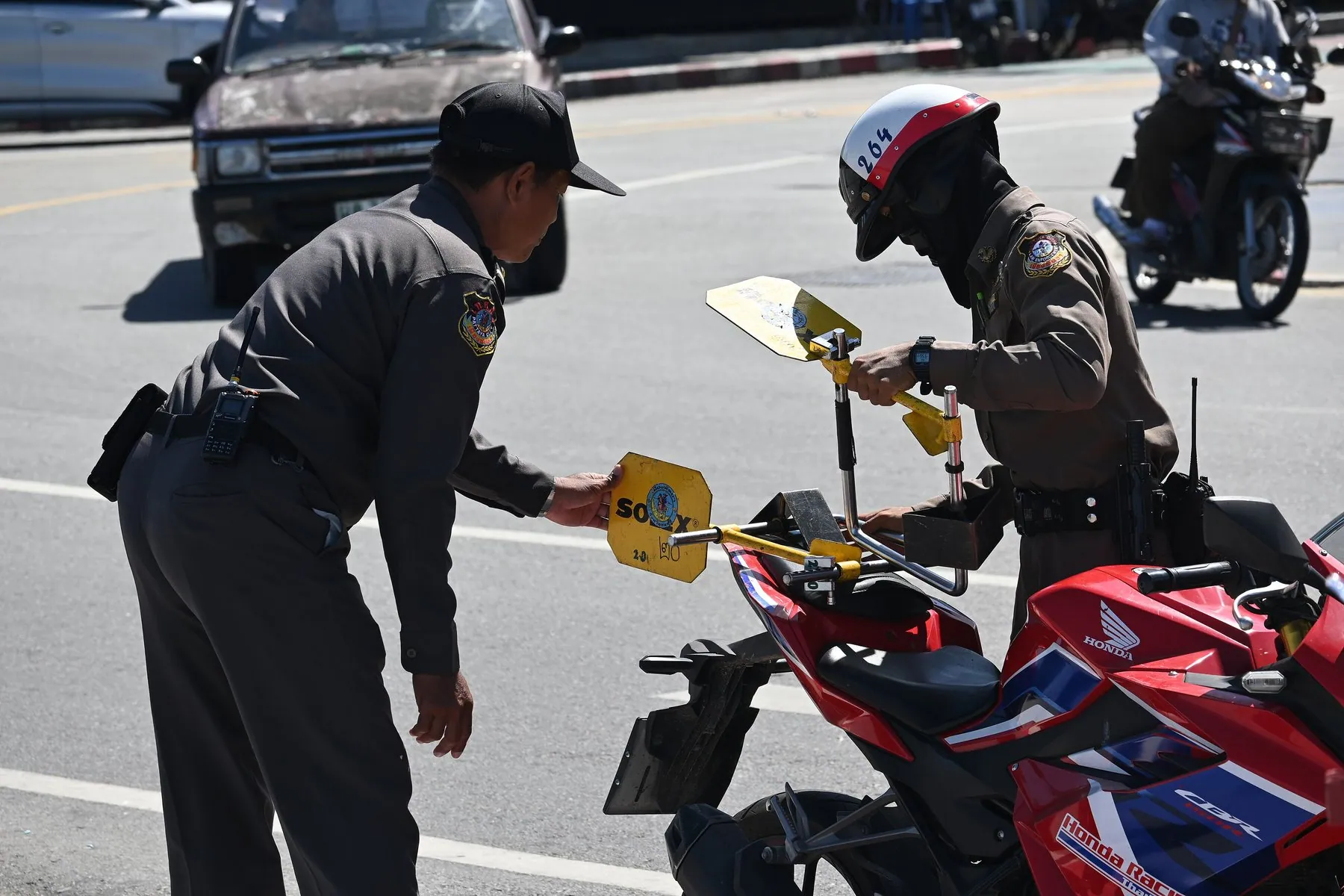
Knowing the maximum is less useful than knowing the procedure. Officers have not been able to confiscate a driving licence at the roadside since September 2019, and a lawful fine is paid at a station or through the official channels, against a receipt. All of that is set out in how a ticket works, how to pay one and what a legitimate receipt looks like. If you are unsure what an officer may ask of you, read your rights as a foreign driver before you need it.
From 1 August 2026, unpaid fines are linked to the vehicle's tax disc — which matters a great deal if you own a vehicle here and rather less if you are on a two-week hire. See unpaid fines.
Why does this show a range instead of one number?
Because Thai law sets ranges and maximums, and the fixed amount for a roadside ticket comes from a police schedule we could not obtain. A single confident number would be easier to read and less honest.
Is the fine different for a foreigner?
The law makes no distinction. See your rights as a foreign driver.
What happens if I just do not pay?
Historically very little happened to a departing visitor, but the position has changed — see unpaid traffic fines. If you are driving a hire car, the rental company will normally charge the fine plus an administration fee to your card.
Does a fine affect my insurance?
A ticket by itself generally does not. Driving without the right entitlement does, and that is a separate and much more expensive problem — see what voids your cover.