At an ordinary Thai traffic stop, an officer can require two things: your driving licence and a copy of the vehicle's registration. That is very nearly the whole of it. The officer can also order you to stop in the first place, can order a breath or drug test where there is reasonable ground to believe you are impaired, and can order a defective vehicle to be repaired. What the officer cannot do is take your driving licence, take your passport, or require you to pay anything at the roadside.
The gap between that short list and what visitors expect is where most anxiety about Thai police comes from. A driver who knows what is being asked, and why, is much harder to unsettle than one who does not.
- Must produceDriving licence and a copy of the registration
- Licence format acceptedOriginal, photocopy or electronic, since 20 Sept 2019
- Licence seizureNo power to seize since 20 Sept 2019
- Roadside cashNo power at all; the lawful outcome is a ticket
What they can require
That you stop
Section 142 of the Land Traffic Act lets a traffic officer or competent official order a driver to stop where the vehicle does not meet the general condition requirements in section 6, or where the officer finds that the driver or anyone in the vehicle is breaching the Act or the law concerning that vehicle. Failing to obey the order is its own offence under section 154, with a fine not exceeding 1,000 baht — roughly £23 / US$30 / €26 — each time.
Your driving licence
You must be able to show a valid driving licence for what you are driving. Since 20 September 2019 you may produce the original, a photocopy, or electronic licence information; there is no obligation to hand over the physical document. If you are driving on a foreign licence, carry the international driving permit with it. Failing to produce a licence at all is a separate, lesser matter from not holding one — see stopped without a licence in Thailand.
A copy of the vehicle registration
The other document a driver is expected to be able to produce. On a hire vehicle this is normally a photocopy of the registration book — blue for a car, green for a motorbike — kept in the glovebox or under the seat; check it is there when you collect the vehicle, because shops do not reliably point it out.
A breath or impairment test
Where there is reasonable ground to believe a driver is intoxicated or otherwise unfit to drive, section 142 says the officer shall order a test. Breath is the primary method under the 2024 ministerial regulation; urine or blood may be used where a breath test cannot be carried out. Refusal is not a way out: the officer may detain you for as long as necessary to complete the test, and refusing without reasonable justification creates a legal presumption that you were over the limit. Refusing a breath test in Thailand goes into what follows.
That a defective vehicle is repaired
Under section 143, where a vehicle does not meet the section 6 condition requirements, the officer may order the owner or driver in writing to have it repaired. Driving it again without a certificate of verification is a fine of up to 1,000 baht plus 500 baht a day until it is fixed.
What the law says
Section 142. A traffic officer or competent official may order the driver to stop the vehicle where the vehicle does not comply with section 6, or where the officer finds that the driver or a person in the vehicle is breaching this Act or the law concerning that vehicle. Where there is reasonable ground to believe the driver has breached section 43(1) or 43(2), the officer shall order the driver to undergo a test.
Section 43 quinque. An Inspector acting under sections 43 bis and 43 ter must produce his identity card to the person concerned.
What they cannot do at a traffic stop
Keep your driving licence
This is the single most out-of-date piece of advice about driving in Thailand still circulating in English. The power to seize a driving licence at the roadside was removed by the Land Traffic Act (No. 12), in force from 20 September 2019. Before that, an officer could hold your licence and issue a substitute receipt that served as a temporary licence for up to seven days, passing the licence to the investigating officer within eight hours. None of that exists now; guidance that describes it is describing the law as it stood before September 2019.
Demand payment at the roadside
Section 140 gives an officer two options on finding a breach: a warning, or a traffic ticket requiring payment of a determined penalty fine. Section 141 then says where that payment is made — the place named on the ticket, or a place gazetted by the Commissioner-General — and provides that on payment the case is deemed settled. There is no third option in the Act, and no roadside cash mechanism at all. What travellers report about informal roadside payments covers the gap between that and what is widely described.
Hold your passport
A traffic stop concerns the vehicle and the driver's entitlement to drive it. Nothing in the traffic-stop power reaches your passport. A photocopy of the photo page and entry stamp is a sensible thing to carry; the original is better in the hotel safe. The same point applies to rental firms that want to keep a passport as security — see passport as deposit for motorbike hire.
Searches: a different power entirely
The authority in section 142 is about traffic compliance and the condition of the vehicle. It is not a search power. Searches of a person or a vehicle are governed by criminal procedure law rather than by the Land Traffic Act, and we have not been able to verify the current Thai provisions — so this site does not attempt to summarise them.
What is safe to say is practical. If a stop moves from documents to a search, the character of the encounter has changed, and so should yours: stay calm and polite, do not physically resist, do not consent to anything you do not understand, and get an English speaker involved. Calling the tourist police on 1155 is the fastest route to that; the number reaches an English-speaking officer of the same national force, 24 hours a day. Where an encounter is heading towards detention or arrest rather than a ticket, what happens if you are arrested and your embassy's consular service are the right references, not this article.
Urine and drug testing is a real power, not a hypothetical one. Section 43 bis lets traffic officers, inquiry officials, competent officers and Inspectors examine drivers of prescribed categories of vehicle for narcotics; if a preliminary test is negative you may continue. Refusing the examination is an offence in itself carrying a fine of up to 1,000 baht, and the officer may detain you until it is completed. There is no published threshold for cannabis or any other drug — impairment is judged by the officer and then by a court. See cannabis and driving in Thailand.
Who is entitled to stop you
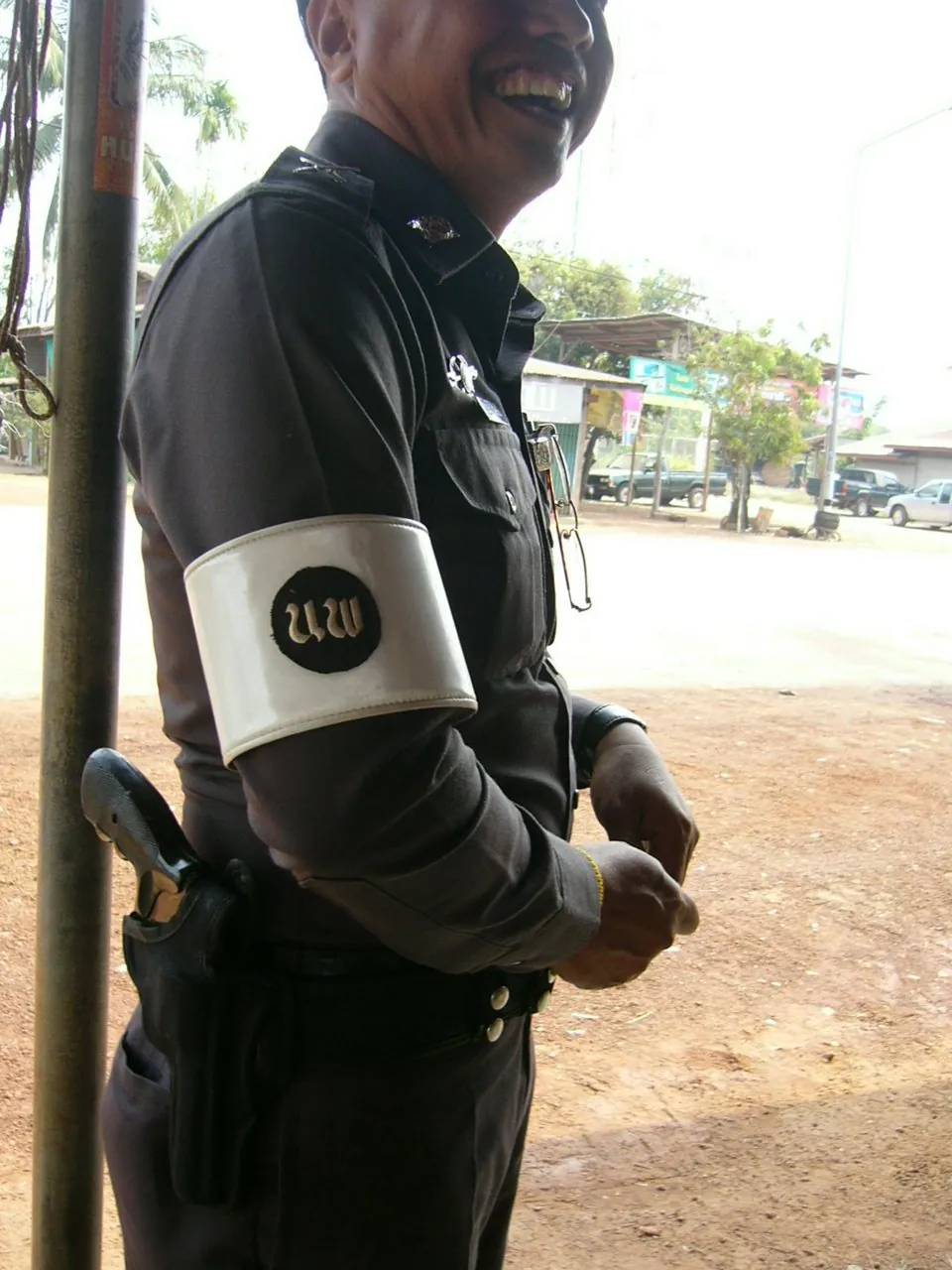
Not everyone in a uniform at the roadside is a traffic officer. The Act allows the Commissioner-General to appoint trained traffic volunteers to assist officials, and while performing those duties they count as officials under the Criminal Code. You will see them directing traffic outside schools, markets and temples. Where an Inspector acts under the drug-testing provisions, section 43 quinque requires them to produce an identity card to the person concerned.
If you are genuinely unsure whether the person in front of you is a police officer, asking politely for a name and a station is a reasonable request.
Ask for things, do not demand them. "Could I have the ticket, please?" and "Which station should I pay at?" are ordinary requests with ordinary answers, and they are also exactly the questions that put an encounter back onto the official track. Your rights as a foreign driver goes through the phrasing that works.
What you should have on you
- Driving licence — original or photocopy, plus the IDP if you are driving on a foreign licence.
- Photocopy of the vehicle registration book, kept in the vehicle.
- The rental agreement, if the vehicle is hired.
- A photocopy of your passport photo page and entry stamp.
- 1155 saved in your phone.
Five items, one plastic wallet, and almost every stop becomes a sixty-second event. Am I legal to drive in Thailand? is the checklist to run before the first day of a trip.
Frequently asked questions
Do I have to give the officer my actual licence, or is a photocopy enough?
A photocopy or electronic licence information is legally sufficient and has been since 20 September 2019. Most officers will take whichever you offer. Carrying a copy and leaving the original somewhere safe is a perfectly reasonable arrangement.
Can Thai police take my licence if I commit an offence?
No. That power was abolished on 20 September 2019. A court can suspend or revoke a licence after conviction for a serious offence — for drink-driving it must — but no traffic officer can take one at the roadside.
Can they make me take a breath test if I have not been drinking?
They can order a test where there is reasonable ground to believe you are intoxicated or unfit to drive, and at a night-time checkpoint that determination is made quickly and often. If you have not been drinking, taking the test is comfortably the fastest way out of the encounter — refusing creates a legal presumption against you that a negative test would have avoided.
Can they search my bag or my scooter?
The traffic-stop power in section 142 is not a search power; search authority comes from criminal procedure law, which this site does not attempt to summarise. If a stop turns into a search, stay calm, do not resist physically, and get 1155 on the phone.
What if the officer asks for something that is not on this list?
Ask what it is for, ask for the officer's name and station, and ask for the written ticket if an offence is alleged. Those three requests are polite, they are normal, and between them they establish whether you are in the official process or somewhere else.