Thai forecourts sell more grades than you are used to, they are almost all ethanol blends, and the names are not the ones on European or American pumps. The short version for a visitor in a hire car: if it is a petrol car, Gasohol 95 is the safe universal choice; if it is a pickup or a large SUV, it is almost certainly diesel and takes B7. Anything else needs checking.
The safest habit is the simplest one. Open the fuel flap when you collect the car and read the sticker inside it, which states the permitted grades. Photograph it. Then, at every forecourt, say the grade out loud to the attendant — you do not fill the car yourself in Thailand — and watch which nozzle they pick up.
- Petrol defaultGasohol 95
- Diesel defaultDiesel B7
- Never guess atE85 — flex-fuel vehicles only
- You do not fill itAn attendant serves every pump
The grades explained
| Grade | What it is | Who should use it |
|---|---|---|
| Gasohol 95 | 95-octane petrol with about 10% ethanol | The safe default for any modern petrol car or scooter in Thailand |
| Gasohol 91 | 91-octane petrol with about 10% ethanol | Small motorbikes and older petrol cars; cheaper than 95 |
| E20 | Petrol with about 20% ethanol | Only vehicles approved for it — most Thai-market cars of the last decade are |
| E85 | Petrol with up to 85% ethanol | Flex-fuel vehicles only. Wrong in anything else. |
| Diesel B7 | Diesel with about 7% biodiesel | The standard diesel; what a hire pickup or diesel SUV takes |
| Diesel B20 | Diesel with about 20% biodiesel | Heavy commercial vehicles approved for it |
| Premium grades | Higher-octane branded petrol and diesel | Optional; no benefit in an ordinary hire car |
Two things to take from that table. First, higher octane never damages an engine, so Gasohol 95 is safe in a car that is specified for 91 — it simply costs a little more. The reverse is not true, and running a car specified for 95 on 91 can make it knock under load. Second, the ethanol content is the real question: E20 and E85 are about what the fuel system can tolerate, not about performance, and putting E85 into a car that is not built for it will damage seals, pumps and injectors.
E85 is the one that causes real damage. It is cheap, the pump is prominent, and in a hurried moment it looks like just another petrol. Unless the vehicle is badged as a flex-fuel vehicle and the filler flap says E85, it is the wrong fuel. The bill for flushing a fuel system will land on your rental deposit — see car rental fuel policies in Thailand.
Colours: do not rely on them
Thai pumps are colour-coded, and the coding is broadly consistent within a brand but not across brands. Gasohol 95 is often orange or green; Gasohol 91 is often yellow or blue; diesel is usually green or black. That is a useful memory aid on a forecourt you have used before, and a poor basis for a decision on one you have not. The number on the pump — 91, 95, E20, E85, B7 — is written in Latin numerals everywhere in the country, so read it rather than trusting the colour.
How a Thai forecourt works
You do not serve yourself. Pull up at the pump, and an attendant will come to the window. Tell them the grade and how much you want. The two phrases that cover almost every transaction:
- "Gasohol 95, full" — or hold up the number of hundreds of baht you want on your fingers. Tem tang means a full tank.
- A cash amount — "500 baht, Gasohol 95" is perfectly normal and is how most Thais buy fuel.
The attendant will show you the pump reading at zero before starting, which is standard practice, not suspicion. Cash always works. Cards are accepted at the major brands, usually at the pump or at a kiosk, but rural stations and the smaller chains may be cash only. Keep enough baht on you to fill a tank.
Fill up before you leave a town, not when the gauge gets low. On the mountain and back-country routes — Route 1148, the Mae Hong Son loop, parts of Isaan — you can go a long way between proper stations, and a scooter's range is shorter than most riders assume. What to do if you misjudge it is in running out of fuel in Thailand.
The brands, and what a station is like
The major networks are PTT, Bangchak, Shell, Caltex, Susco and PT. On main highways their stations are substantial places: multiple pumps, a 7-Eleven or a branded convenience store, a Café Amazon or similar, clean toilets, an air line, and often a cluster of food outlets. In Thailand the petrol station is the service area — there is no separate motorway services culture — and the big forecourts are genuinely pleasant places to break a journey. See service areas and rest stops on Thai highways.
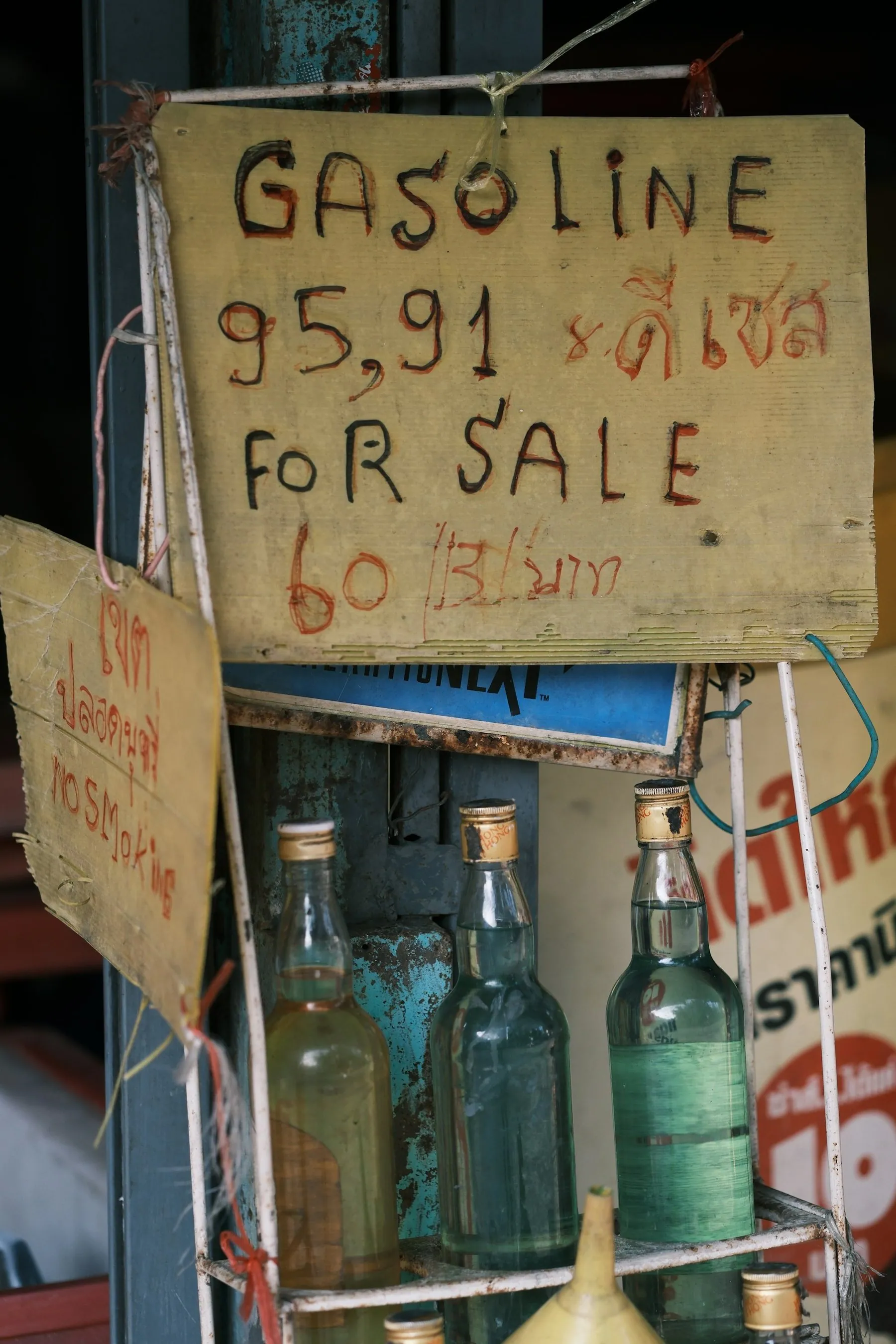
In villages and on back roads the picture changes. You will find single-pump stations, sometimes with hand-cranked dispensers, and roadside stalls selling petrol by the litre out of bottles or a small metered drum. Both are entirely normal and both are fine for a scooter in a pinch. The bottled fuel is usually Gasohol 91 and usually a little more expensive than the forecourt price, and nobody is trying to cheat you; it is a convenience service in places without a station.
Motorbikes and scooters
Almost every rental scooter in Thailand runs on Gasohol 91, and most shops will tell you so when they hand it over. Gasohol 95 does no harm. The practical points for a rider:
- Rental scooters are handed over with very little fuel. Assume you need to fill up within the first few kilometres.
- Small tanks mean short range — a 110cc automatic will not do a mountain day on one fill.
- Switch the engine off while the attendant is filling.
- On the smaller machines the fuel filler is under the seat, so take your helmet, bag and everything else out first.
- Bottled roadside fuel is fine for a scooter and often the only option in the hills.
Prices, and the fuel policy on a hire car
Prices are set nationally by the brand with regional variation, and they change often — every station displays them on a large board at the entrance, by grade. Diesel and Gasohol 91 are cheaper than Gasohol 95; E20 sits between them; E85 is cheapest per litre and worst on consumption.
Almost every Thai car rental works on a full-to-full basis: you get it full and return it full, with a receipt if the desk asks for one. Fill up within a few kilometres of the drop-off, keep the receipt, and photograph the gauge. That single habit prevents the most common end-of-hire dispute — see returning a hire car in Thailand without a dispute and car rental fuel policies.
LPG, NGV and electric
Thailand has a large fleet of LPG and NGV taxis, and you will see dedicated filling islands for both. These are not something a hire car will need; conversions are not permitted on rental fleets and a converted vehicle would be flagged in its paperwork.
Electric vehicles are a different matter and are arriving quickly. Charging is concentrated in Bangkok, on the main corridors and at the larger PTT and shopping centre sites, and it thins out sharply once you leave them. If you are offered an EV by a rental desk, plan the charging before you accept it, particularly for anything involving northern mountain roads.
What fuel should I put in a Thai hire car?
Gasohol 95 for a petrol car, Diesel B7 for a diesel. Check the sticker inside the filler flap, and tell the attendant the grade out loud.
Is Gasohol the same as petrol?
Yes — it is petrol with ethanol blended into it. Gasohol 91 and 95 refer to the octane rating, and both contain roughly 10% ethanol.
What happens if I put E85 in an ordinary car?
It can damage the fuel system. E85 is for flex-fuel vehicles only. If you realise before the engine has been started, do not start it — tell the station and call the rental company.
Can I fill up the car myself?
No. Thai forecourts are attended, and the attendant operates the pump. You stay in or beside the car and tell them what you want.
Do petrol stations take credit cards?
The major brands generally do. Smaller chains and rural stations are often cash only, so carry enough baht for a tank.
What fuel does a rental scooter take?
Gasohol 91 in almost every case, and Gasohol 95 causes no harm. Rental bikes are usually handed over nearly empty, so fill up straight away.
Is roadside bottled petrol safe?
For a scooter, yes — it is a normal village service, generally Gasohol 91 and a little dearer than a forecourt. For a car, use a proper station.