Thai trains will carry a bicycle, but only on services with a freight car, and only if you do the paperwork at the station on the day of travel. Long-distance coaches will usually take one in the luggage bay for a negotiated fee. Minivans generally will not. Songthaews will put it on the roof. Domestic flights treat it as sports equipment, with the same airline-by-airline variability you met flying in. None of it is difficult; all of it takes longer than you expect.
This is a touring cyclist's article. Being able to move a bicycle by train or bus is what makes Thailand a flexible country to ride in — it lets you skip the dull Bangkok corridor, bail out of a stage that has gone wrong, and combine two regions in one trip without riding the boring bit in between.
- TrainsYes, on services with a freight car
- CoachesUsually, in the luggage bay
- MinivansUsually not
- Domestic flightsYes, as sports equipment, booked ahead
Trains
The State Railway of Thailand carries bicycles as freight rather than as luggage. That means the bicycle does not travel with you in the carriage; it goes in a freight or parcels car, and not every train has one. As a general rule the long-distance intercity services on the northern, northeastern and southern lines do have freight carriages and can take a bicycle; local and commuter services frequently do not.
The process, in order:
- Buy your own passenger ticket first, in advance if you want a sleeper
- Go to the freight and parcels office at the station on the day of travel — this cannot generally be done in advance
- Buy a separate cargo ticket for the bicycle. The charge is modest; expect something in the order of a hundred baht rather than a serious expense
- Load the bicycle yourself into the freight car, and unload it yourself at the other end
- Arrive early. Several hours before departure is the standard advice, and it is not overcautious
Take the panniers off and carry them with you. Remove anything that can be unclipped — computer, lights, pump, bottles — because the bicycle will be stacked against other freight. Some riders tape a card with their name and destination to the frame; it is a sensible habit.
The overnight sleeper from Bangkok to Chiang Mai, and the northeastern services to Nong Khai and Ubon Ratchathani, are the classic cyclist's moves in Thailand: you sleep, the bicycle travels, and you start riding in the morning where the good roads begin. It removes the two worst stretches of highway in the country from your itinerary.
Do not turn up half an hour before a long-distance train with a bicycle. The parcels office is often at the other end of the station from the ticket hall, it closes before departure, and if you miss it the bicycle does not travel. Build in a couple of hours.
Coaches and long-distance buses
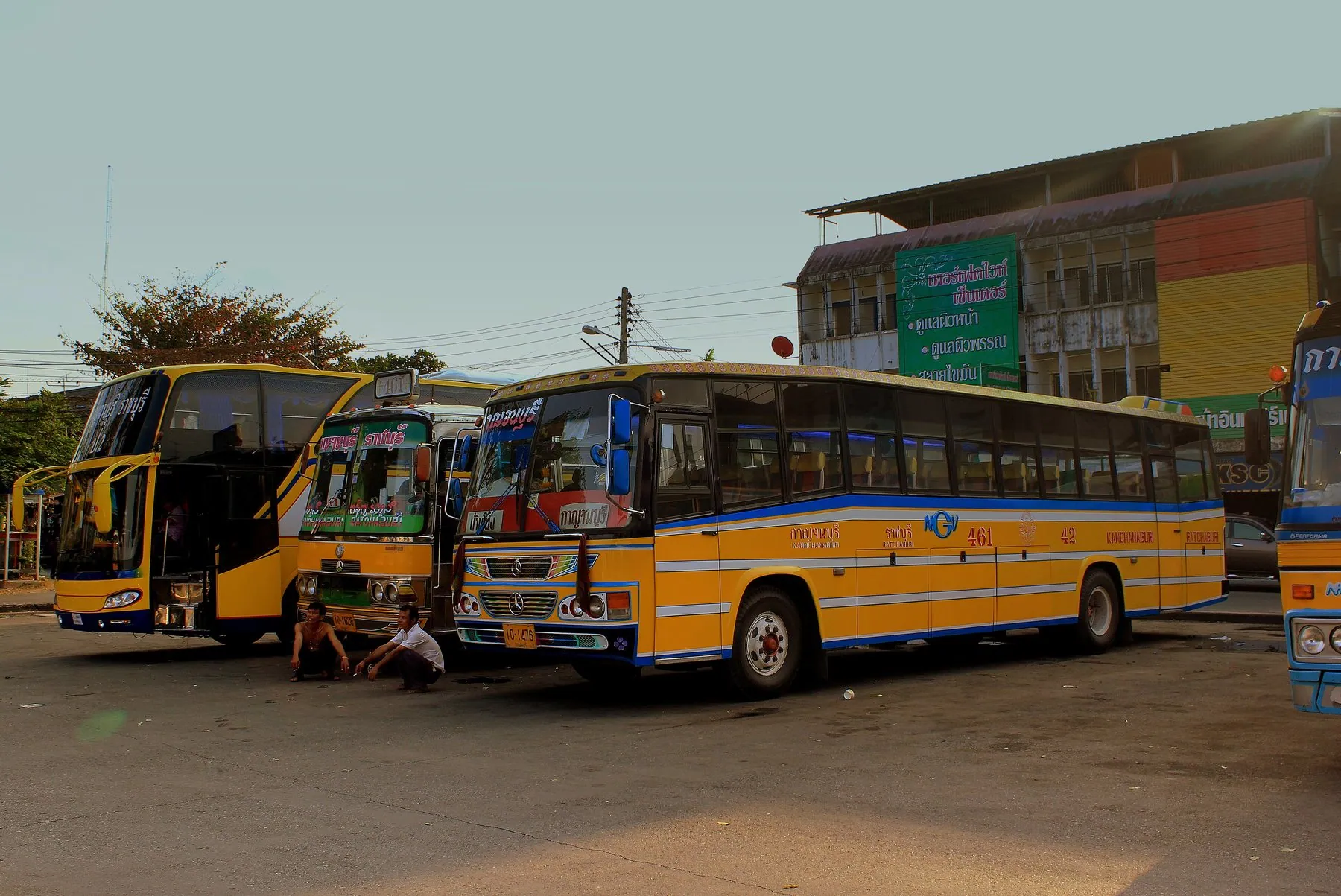
Government and private long-distance coaches will usually take a bicycle in the luggage bay underneath. This is a negotiation with the driver or the loader rather than a formal policy, and the answer is generally yes, sometimes for a small fee, occasionally for nothing.
What helps:
- Turn the handlebars parallel to the frame and take the pedals off — two minutes' work that changes a refusal into a shrug
- Remove the front wheel if the bay is shallow
- Arrive early, before the bay fills with suitcases
- Be present at loading and ask them not to stack anything on the drivetrain side
- Carry a couple of old plastic bags to keep grease off other people's luggage — this is genuinely what turns a hesitant driver into a helpful one
Bus stations in Thailand are chaotic and the process is informal. Nobody will refuse to help; they may not understand what you want until you show them. Buses run everywhere, which is what makes them the reliable escape route from a stage that has gone wrong — the point made in planning a quiet-road cycling route in Thailand.
Minivans
The awkward one. Minivans have replaced buses on a great many medium-distance routes in Thailand, and they have no luggage bay — bags go in the back row of seats or in a small rear space. A bicycle does not fit.
Occasionally a driver will strap one to the roof, and occasionally you will find a van with a rack. Do not plan on it. If your route depends on a minivan leg, work out an alternative in advance: a coach on the same corridor, a train, or a hired pickup.
Songthaews and pickups
The most useful vehicle in Thailand for a cyclist in trouble. A songthaew — a pickup with benches in the back — will take a bicycle for a negotiated fare, either standing in the bed or on the roof rack. In the mountains they are the standard way of getting a broken bicycle or a broken rider down to a town.
Agree the fare before the bicycle goes on. Hold it or tie it rather than trusting it to stay upright, and be aware that the roof rack of a songthaew on a Thai mountain road is not a gentle environment. How songthaews behave in traffic, which is worth knowing when you are riding near them rather than in them, is in songthaews and how they stop.
Domestic flights
Thailand's domestic network is extensive and cheap, and it treats bicycles the way international carriers do: as sports equipment, subject to a fee, size limits and advance booking. The low-cost carriers that dominate domestic routes have stricter limits and less flexible staff than full-service airlines, and they are exactly the airlines you will be flying.
Book the bicycle when you book the seat, check the maximum dimensions rather than just the weight, and box or bag it — a naked bicycle handed over at a domestic check-in desk will usually be refused. If you flew in with a box or bag, this is the reason to keep it rather than discard it, which is one of the arguments in bringing your own bike to Thailand.
Boats and ferries
The easiest of all. Thai ferries and longtail boats carry bicycles routinely — vehicle ferries without fuss, passenger boats on the roof or in the bow. Speedboats are the least reliable. Salt spray is the cost, and the fix is rinsing and re-lubricating afterwards. The detail, island by island, is in cycling on Thailand's islands, and the vehicle-ferry side in taking a car or motorbike on a Thai island ferry.
Which to use for what
| Journey | Best option |
|---|---|
| Bangkok to Chiang Mai | Overnight train, freight car. Book the sleeper ahead, do the bike at the station |
| Bangkok to Isaan | Overnight train to Nong Khai or Ubon Ratchathani |
| Bangkok to the south | Train to Surat Thani or Trang; coach as the backup |
| Within the north | Coach, or a songthaew for short hops |
| Anywhere a minivan is the only service | Hire a pickup, or reroute |
| Long distance, short on time | Domestic flight, booked as sports equipment, bike boxed |
| To an island | Ferry. Almost always straightforward |
Riding out of the station
One practical note. You are not allowed to ride a bicycle on a Thai station platform — push it. And the roads immediately outside major stations, particularly Hua Lamphong and Bang Sue in Bangkok, are among the least pleasant in the country: heavy traffic, no shoulder, and a lot of confused traffic circling for the entrance. Have a route out planned before you arrive rather than working it out in the forecourt with the bicycle half assembled. The general habits are in how to cycle safely in Thai traffic, and the specifics of Bangkok's roads in cycling in Bangkok.
Frequently asked questions
Can I take a bicycle on a train in Thailand?
Yes, on trains that have a freight or parcels car — generally the long-distance intercity services on the northern, northeastern and southern lines. The bicycle travels as freight, not with you, and you buy a separate cargo ticket at the parcels office on the day of travel.
How much does it cost to take a bike on a Thai train?
Modest — in the order of a hundred baht rather than a significant expense, varying with the service. Rates change; check at the parcels office when you buy the ticket.
Do Thai buses take bicycles?
Long-distance coaches usually will, in the luggage bay, for a small fee or none. It is an informal negotiation with the driver. Turn the bars, take the pedals off and arrive early, and the answer is almost always yes.
Can I take a bicycle in a Thai minivan?
Generally no — minivans have no luggage bay and a bicycle will not fit inside. If a leg of your route is minivan-only, plan an alternative before you get there.
Can I fly domestically in Thailand with a bicycle?
Yes, as sports equipment, booked and paid for in advance and packed in a box or bag. The domestic market is dominated by low-cost carriers with strict size limits, so check dimensions carefully.
What is the best way to get a bike from Bangkok to Chiang Mai?
The overnight sleeper train. You sleep, the bicycle rides in the freight car, and you wake up where the good roads start — see cycling in Chiang Mai for what to do when you get there.