Most of what differs about driving in Thailand is small, cheap and quickly absorbed: the fuel grades have unfamiliar names, the maps app behaves oddly with sois, you pay tolls in cash, the rain arrives faster than you can pull over. A handful of things are expensive to get wrong, and all of those are paperwork rather than driving — the licence entitlement you did not know you needed, the insurance clause you did not read, the hire agreement you signed without looking at the excess.
This page is the pre-departure briefing: the things worth sorting out before you fly, and the things that will simply be different once you arrive. If you only act on one section, make it the first one.
- Side of the roadLeft
- Sort before you flyLicence entitlement, IDP, insurance wording
- Sort on arrivalFuel grade, tolls, navigation, parking
The three things to do before you leave home
1. Check what your licence actually entitles you to
Thailand issues car and motorcycle entitlement as separate licences, and the international conventions carry motorcycles as a separate category on the permit. A car-only licence gives you nothing on two wheels — and there is no small-engine exemption, because Thailand declared under the 1968 Convention that it treats mopeds as motorcycles. A 110cc automatic scooter is a motorcycle for these purposes. Nobody at the rental shop will point this out. Which licence can I use in Thailand is the full answer.
2. Get an International Driving Permit
Which one depends on your nationality, and both answers are correct for different readers. Thailand is a party to both the 1949 Geneva and 1968 Vienna road traffic conventions, so British, German, Dutch, French and Nordic readers want the 1968 permit, while American, Australian, Irish, Canadian, New Zealand and Japanese readers can only obtain the 1949 one, because their own countries are not 1968 parties. You cannot buy one after you land — the UK government's wording is blunt: "You cannot buy an IDP outside the UK, so get one before you travel." The same principle applies everywhere. See the International Driving Permit for Thailand.
3. Read your travel insurance policy's motorcycle clause
Not the summary, the wording. This is the document that decides whether a crash costs you a few thousand baht or several hundred thousand, and the clause that matters is usually a single sentence about what licence you must hold. Does travel insurance cover driving in Thailand walks through what to look for and what the wording actually says.
None of this can be fixed after a crash. The rental shop hands over the scooter regardless of what is in your wallet, so nothing goes wrong at the point of hire. The consequence appears only at the claim, when an insurer asks what entitlement you held. Work through the five-question legality checklist before you book anything.
What is genuinely different about the driving
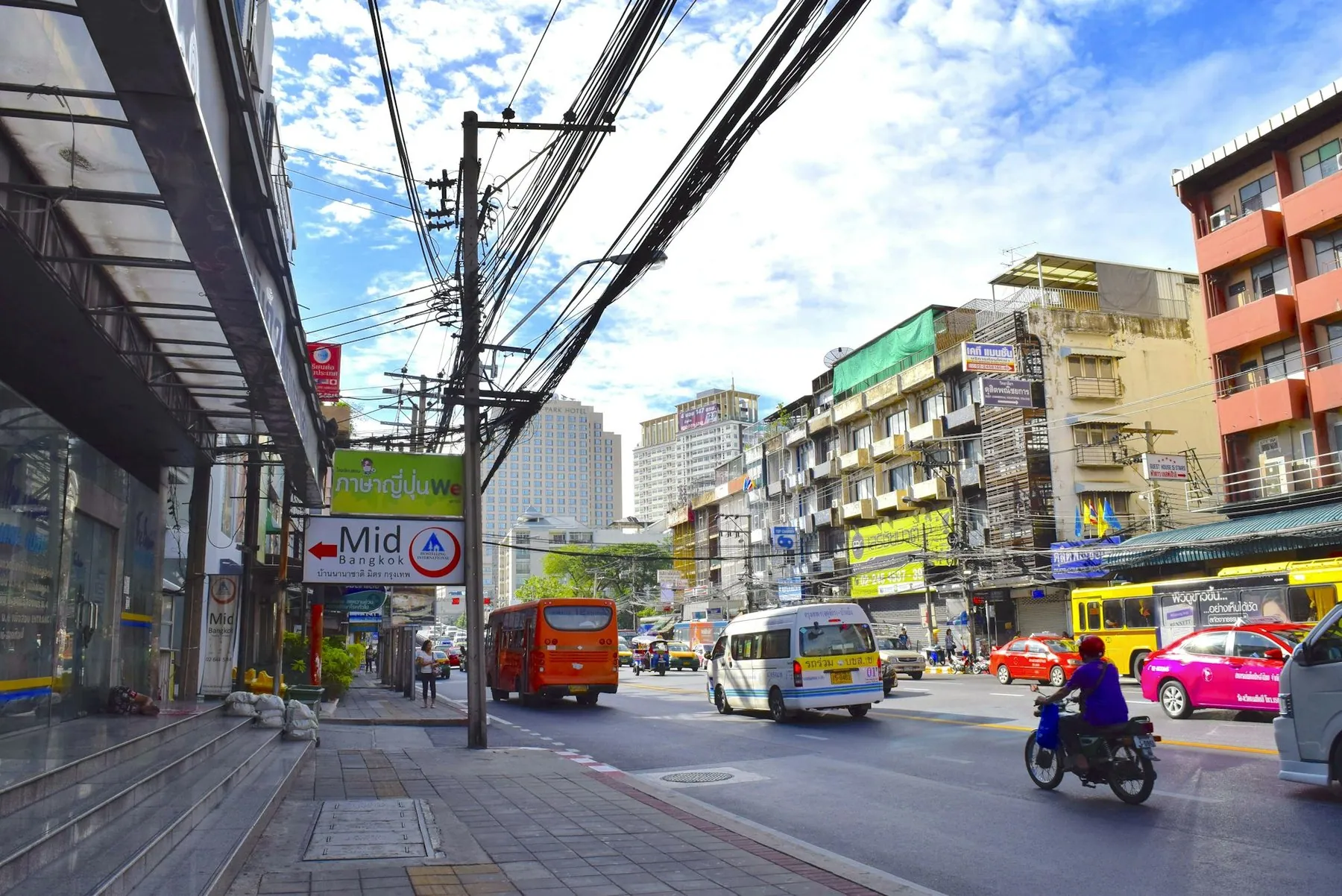
Traffic runs on negotiation, not priority
Priority follows size, speed and commitment far more than the rulebook. Vehicles ease into gaps, hesitation gets you nothing, and nobody expects you to be granted a right of way. It is a functioning, low-aggression system once you understand it, and how Thai traffic actually works explains the logic.
You cannot turn right across a divided highway
Thai highways are usually barrier-divided with no right turns. You drive past your destination to a signposted U-turn slot, turn through 180 degrees and come back. Many slots are at grade with no signals, so you pull across fast traffic from a standing start. It is the manoeuvre most worth treating carefully.
Motorbikes are everywhere, in every gap
Small motorcycles are Thailand's dominant vehicle. They filter, use the hard shoulder in both directions, and appear beside you in spaces you did not register. Mirror-check every lane change properly, and look both ways at every exit — shoulder traffic may be coming from the direction you dismissed.
Signs are mostly bilingual, mostly
The national highway network is signed in Thai and Latin script and is easy to follow. Romanisation is inconsistent, so the same town may appear three ways in fifty kilometres — Ayutthaya, Ayuthaya and Ayudhya are the same place. Off the numbered network, signage becomes Thai-only.
Speed limits are posted and variable
Do not carry an assumption from home. Limits vary by road type, vehicle class and designated section, and the sign on the road governs — including the 120 km/h sections introduced in 2021 on qualifying divided highways, which are signposted as such.
The practical stuff you will meet in the first two days
| Thing | What to expect |
|---|---|
| Fuel | Attendant service is normal; you rarely fill your own. Grades are labelled Gasohol 91, Gasohol 95, E20, E85 and diesel. Putting the wrong one in is a real risk and is not covered by any waiver you have bought. See which grade goes in your tank. |
| Tolls | Cash lanes still exist on most expressways; electronic lanes need a transponder or a registered plate. If your hire car has a tag, ask at the desk how it is billed; if it has not, stay out of those lanes. |
| Navigation | Works well on main roads, less well with soi numbering and U-turn slots, and will happily route you the wrong way down a one-way lane. Which navigation apps actually work here. |
| Parking | Malls and hotels have vast car parks, often free with validation. Kerbside rules are colour-coded rather than signed. In Bangkok, parking is the reason many visitors abandon driving. |
| Rain | In the wet season a downpour arrives in minutes and reduces visibility to almost nothing. Thai drivers pull under bridges and wait it out. Copy them. |
| Night | Dusk lasts about twenty minutes this close to the equator, and rural roads are unlit with unlit vehicles on them. Driving at night in Thailand. |
| Police stops | Routine, usually a licence-and-helmet check, usually 90 seconds if your documents are in order. Keep your documents in one place and it is a non-event. |
What to have with you in the vehicle
- Your home driving licence and your IDP, together. The IDP is not a licence on its own — it is worthless without the domestic permit whose number is written in it.
- A copy of the vehicle registration document. The hire company should provide one; ask if it is not in the glovebox.
- The rental agreement, including the page with the excess on it.
- Your passport or a good copy of the photo and visa pages. Do not leave the passport itself as a rental deposit.
- Your insurer's 24-hour emergency assistance number, saved offline as well as in the app.
- The Tourist Police number, 1155, for an English-speaking officer.
A photocopy is legally sufficient. Since September 2019 a driver in Thailand may produce the licence, a photocopy of it, or electronic licence information, and a traffic officer no longer has the power to confiscate a licence at the roadside. That is useful to know at a checkpoint, though carrying the originals remains the path of least friction.
Money, deposits and the paperwork at the desk
Hire cars in Thailand are almost all automatic, which removes one adjustment entirely if you are used to shifting with your right hand. Booking is straightforward; the two things that catch people are the excess and the deposit.
The excess is what you pay if the vehicle is damaged even after the collision damage waiver has done its work, and the exclusion list matters more than the headline number — tyres, wheels, glass, keys, plates and wrong fuel typically sit outside the waiver entirely, even on a zero-excess product. The Renting section covers it in full.
On scooters, the standard practice of leaving a passport as security is something to refuse. Offer a cash deposit or a photocopy instead.
A realistic first week
If you are hiring a car, collect it somewhere other than the middle of Bangkok if you have the choice — an airport desk with a straight run to an expressway is a far gentler start than a city-centre branch. Do your first drive in daylight, with the navigation set before you move, and allow a longer margin than you would at home.
If you are hiring a scooter, ride it around the forecourt first, check both brakes and both lights, film the machine before you take it, and make your first ride a short one in daylight. Nothing about riding here gets easier by starting at night on an unfamiliar hill.
Frequently asked questions
Can I drive in Thailand on my home licence alone?
It depends where the licence is from, and the honest answer is that you should not rely on it. A licence conforming to the 1968 Convention is entitled to recognition, and the Department of Land Transport said as much when the Convention took effect for Thailand in 2021 — but the UK government still instructs its citizens to carry a 1968 IDP alongside the licence, and rental companies ask for one. The permit costs very little and removes the argument.
How hard is driving on the left if I have never done it?
Easier than you expect on open road, harder than you expect in car parks, at junctions and when you are tired. Give it a day, and start somewhere quiet rather than in a city.
Do I need to speak or read any Thai?
No. The numbered highway network is bilingually signed and navigation apps work. Recognising the Thai numerals helps once you are off the main roads, but it is a convenience rather than a requirement.
What happens if I get a speeding ticket?
Camera tickets go to the registered owner, which for a hire car is the rental company, and typically reappear as a charge to your card weeks later. Roadside tickets are a demand for payment at a bank, a convenience store, a post office or online, not for cash on the spot.
Should I bring my own helmet?
If you are planning to ride for more than a couple of days, yes, or buy a decent one here. Rental helmets are frequently the wrong size, unfastened, or not to any useful standard.