Chiang Rai city takes about ten minutes to cross and almost nothing you came for is inside it. The White Temple is a dozen kilometres south. Mae Sai and the Myanmar border are an hour north. Chiang Saen and the Mekong are an hour northeast. Mae Salong, Doi Tung, the tea hills and Chiang Khong are all half a day's driving away and none of them is served by anything convenient. That is the whole proposition of driving here: the city is easy, and the distances around it are what need planning.
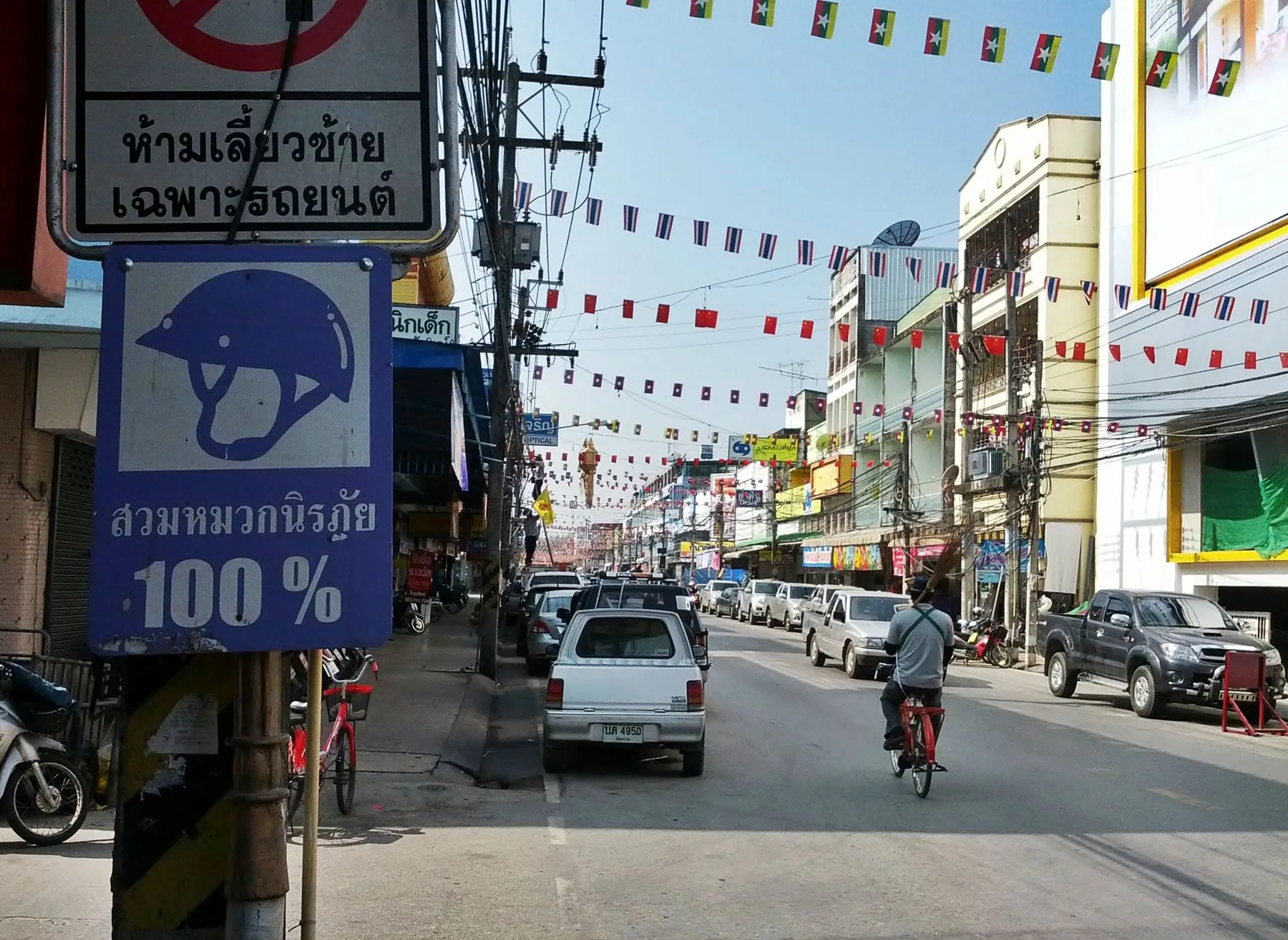
As a place to drive, Chiang Rai is among the gentlest provincial capitals in Thailand. Traffic is light, the grid is small, drivers are unhurried, and there is almost always somewhere to park. If Chiang Mai felt manageable, this will feel empty.
- Main roadHighway 1, Phahonyothin Road, north to south
- To the White TempleAbout 12 km south
- To Mae Sai and the borderAbout 60 km north on Highway 1
- To Chiang MaiAround 180 km, three hours or more on Highway 118
The city itself
Chiang Rai's centre is built around the Clock Tower, at the junction of Phahonyothin Road and Singhakhlai Road. It is gold, it is unmissable, and it runs a light and sound show in the evening — which means that for a few minutes at a time, several times a night, traffic around it slows to a crawl while people stop to watch. Plan around that if you are crossing town after dark.
Phahonyothin Road is Highway 1, and it runs straight through as the town's main axis. The bus station, the night bazaar, most of the hotels and the older commercial streets sit within a few blocks of it. Away from that spine the streets are quiet, two-way and lightly used. There is a walking street market at the weekend that closes a central street to vehicles in the evening; ask at your hotel which one and when, because it moves the parking situation for a few hours.
Chiang Rai's airport is a short drive north of the centre on Highway 1 — close enough that collecting a hire car there and driving straight into town is a non-event. Practicalities are in airport car rental in Thailand.
Chiang Rai is a good place to get comfortable with Thai roads before doing anything ambitious. Spend the first afternoon driving out to the White Temple and back — it is a straightforward run south on Highway 1 with a big car park at the end — and you will have covered a dual carriageway, a U-turn, a busy junction and a large car park before you attempt a mountain road.
Parking
Straightforward. Central Plaza on the edge of town has a large car park, the supermarkets have their own, and most hotels provide parking. On-street parking is available in much of the centre, and the national kerb-colour rules apply — red and white means no stopping, yellow and white means a brief drop-off only. Around the Clock Tower, the night bazaar and the weekend walking street the kerbs fill in the evening, and that is the one time of day you may have to walk a few minutes. The underlying rules are in parking rules in Thailand.
The roads out
This is what you are really here for. Chiang Rai sits at the junction of several of the best roads in Thailand.
| Destination | Road | Roughly | Character |
|---|---|---|---|
| White Temple (Wat Rong Khun) | Highway 1 south | 12 km | Easy dual carriageway, large car park |
| Mae Sai / Myanmar border | Highway 1 north | 60 km | Fast main road, busy border town at the end |
| Chiang Saen and the Mekong | Route 1016 northeast | 60 km | Flat, quiet, river at the end |
| Doi Tung and Mae Salong | Hill roads off Highway 1 | 60–90 km | Steep, twisting, superb |
| Chiang Khong (Laos crossing) | East via the 1020 corridor | Around 110 km | Rolling, rural, straightforward |
| Chiang Mai | Highway 118 southwest | Around 180 km | Three hours-plus, mountain sections |
The classic use of Chiang Rai as a base is the two- or three-day circuit taking in Mae Salong, Doi Tung, Mae Sai and the Mekong at Sop Ruak — laid out in driving the Golden Triangle loop from Chiang Rai. The run over to Chiang Mai is covered in Chiang Mai to Chiang Rai on Highway 118, and if you are heading further into the back country, Route 1148 and the northern back roads starts within reach.
What the hill roads demand
The moment you leave the valley floor, Chiang Rai's roads change character completely. The climbs to Mae Salong and Doi Tung are steep, narrow in places, and made of continuous bends with limited sight lines. They are beautifully surfaced — Thailand's Department of Highways looks after these roads well — but they ask things of a vehicle and a driver that a city road does not.
Small scooters and northern hills are a poor match. A 110cc automatic will overheat its brakes on a long descent and may not pull a passenger up a sustained climb at all. If you intend to ride the hill roads, hire something with a manual or semi-automatic gearbox and enough engine to use engine braking on the way down. The technique is in mountain roads and hairpin bends, and local hire is in renting a motorbike in Chiang Rai.
Season matters more here than in most of Thailand
Chiang Rai has three quite different driving seasons.
Cool season, roughly November to February. The best driving weather in Thailand — clear, dry and cold enough at dawn in the hills for genuine fog and, on the higher roads, for the surface to be damp well after sunrise. Take a jacket if you are riding; visitors are routinely caught out by how cold a highland morning here is.
Burning season, roughly February to April. Agricultural burning fills the northern valleys with smoke. Visibility on the hill roads can drop badly, the viewpoints show nothing at all, and the air is genuinely unpleasant. Drive with dipped headlights and do not count on seeing the Mekong from a hilltop in March.
Rainy season, roughly June to October. Green, empty and rewarding, but the hill roads collect run-off, small landslips are common on the steeper sections, and afternoon storms arrive fast. Do the climbing in the morning. See the rainy season and flooded roads.
The other traffic
Outside town you will share the road with agricultural vehicles — tractors, two-wheeled walking tractors towing trailers, pickups loaded past the axle — moving much more slowly than you and often without functioning lights. On the border roads there are lorries. In the villages there are dogs, children and livestock. None of this is difficult, but it argues strongly for driving in daylight, which is the consistent theme of driving in northern Thailand.
Distances here also mislead. A 90 km hill route is not a 90-minute drive; on the roads to Mae Salong or over towards Nan, an average of 40 km/h is realistic and you should plan accordingly. The driving time calculator is built around that difference.
Is Chiang Rai easy to drive in?
Yes. It is a small city with light traffic, a simple layout around Highway 1 and the Clock Tower, and easy parking. The demands are all outside the city, on the hill roads.
How far is the White Temple from Chiang Rai?
About 12 km south on Highway 1, with a large car park on site. It is a simple drive and a good first outing in a hire vehicle.
How long does it take to drive from Chiang Rai to Chiang Mai?
Around three hours for roughly 180 km on Highway 118, more if you stop or if the weather is poor. The longer, prettier alternatives take most of a day.
Do I need a car or is a scooter enough?
A scooter is fine for the city and the easy runs south and north on Highway 1. For the hill loops, either hire a bike with proper gears or take a car — particularly if there are two of you.
When is the best time of year to drive around Chiang Rai?
November to early February: dry, clear and cool. Avoid late February to April if views matter to you, because of the burning-season haze.
Can I drive from Chiang Rai into Laos or Myanmar?
Crossing on foot at Mae Sai or Chiang Khong is one thing; taking a vehicle across is quite another, and a rental almost certainly cannot go. See crossing into Laos by road and can you take a rental vehicle out of Thailand?